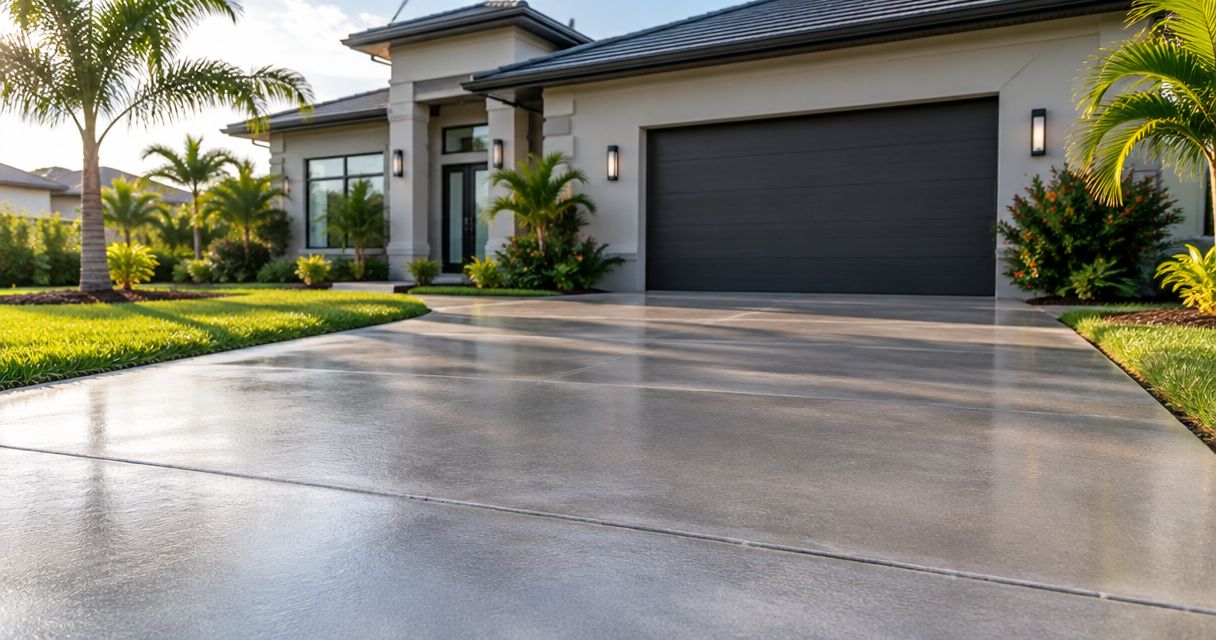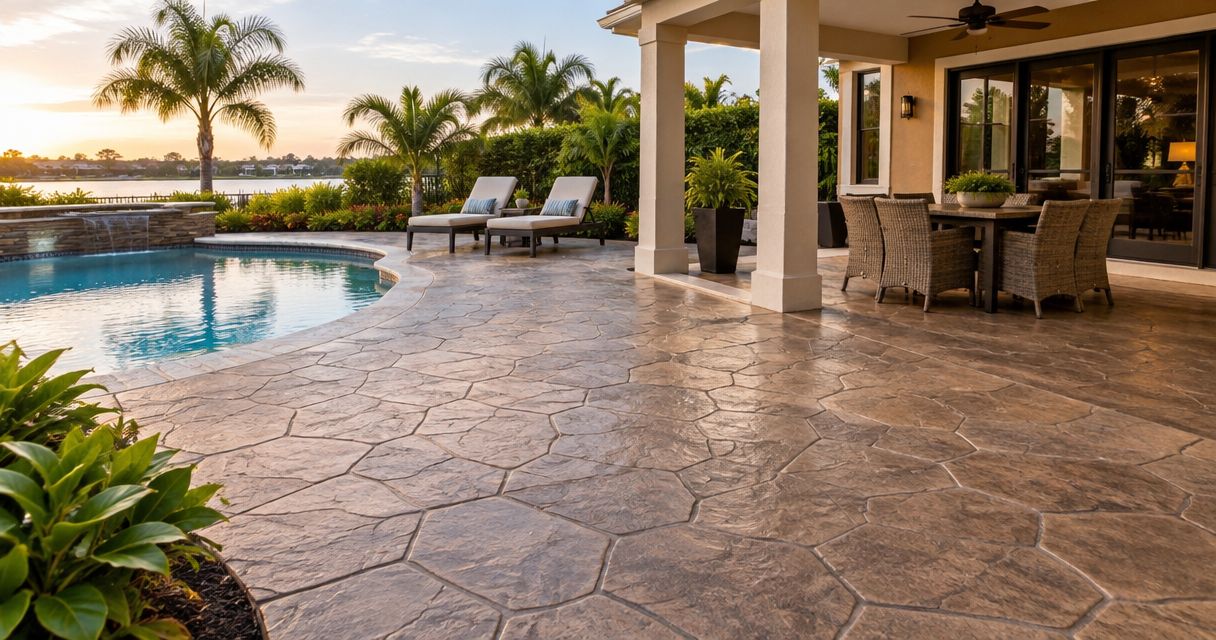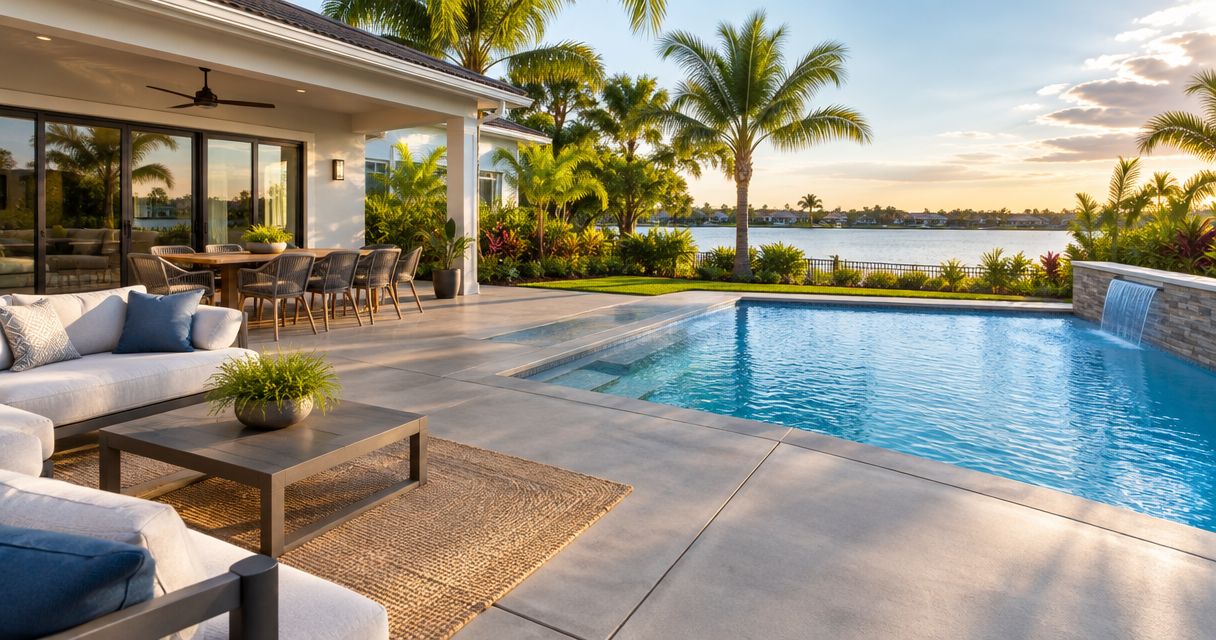
Best overall: a broom-finished concrete patio. Best for a decorative focal point: stamped concrete. Best for a simple, budget-conscious layout: scored concrete. These are the strongest starting points for a Florida backyard in 2026; the right choice depends on drainage, surface texture, maintenance, and how you use the space.
- Best concrete patio designs Florida homeowners should shortlist: broom-finished, stamped, scored, integrally colored, and exposed aggregate.
- Broom-finished concrete is the default recommendation for a practical backyard patio with deliberate surface texture.
- Stamped concrete suits decorative seating areas, but pattern depth and sealer affect maintenance and wet footing.
- Green Hammer Concrete provides concrete patio installation and repair for residential and commercial property owners in Palm Bay and Brevard County.
Why this matters
A patio finish cannot correct a slab that sends rainwater toward your house. In Florida, drainage and wet footing belong in the design discussion before patterns and colors. Decide where water should go, then choose a surface that fits your furniture, footwear, and cleaning routine.
Green Hammer Concrete is a concrete patio contractor for Palm Bay and Brevard County property owners who need installation or repair. Start your 2026 project discussion with Green Hammer Concrete by describing the existing ground, nearby doors, and what you want the patio to accommodate.
What makes the best concrete patio designs for Florida?
Use these criteria to compare a 2026 patio proposal before choosing the finish:
- Drainage: The slab needs a planned water path that accounts for doors, foundations, adjoining ground, and existing drainage features.
- Wet footing: Texture and the final sealer both affect how a surface feels underfoot. A decorative pattern alone does not establish slip resistance.
- Comfort: Evaluate texture with the footwear you actually use. A comfortable shoe-wearing surface can feel rough on bare feet.
- Maintenance: Consider cleaning access, surface recesses, and any coating or sealer requirements before selecting an appearance.
- Repair expectations: Concrete can crack. Joints help manage cracking, but they do not guarantee a crack-free slab or an invisible future repair.
- Layout: Keep chair movement, door operation, and walking routes in the plan rather than squeezing them into leftover space.
Florida concrete patio designs at a glance
These options describe finishes and treatments, not separate structural systems. You can combine some of them: integrally colored concrete can receive a broom finish, while scored lines can organize a plain slab.
| Rank and design | Best for | Standout feature | Key limitation |
|---|---|---|---|
| 1. Broom-finished concrete | Everyday dining and backyard use | Straightforward textured surface | Limited decorative detail |
| 2. Stamped concrete | A decorative seating-area focal point | Imprinted stone, tile, or other patterns | Recesses and sealers require attention |
| 3. Scored concrete | A simple geometric layout | Lines divide the surface into visual panels | Decorative scoring does not automatically replace control joints |
| 4. Integrally colored concrete | Coordinating the patio with the house | Pigment incorporated into the concrete | Color variation and repair matching remain visible concerns |
| 5. Exposed aggregate | A textured garden-side gathering space | Visible aggregate creates surface character | Coarse textures can be uncomfortable barefoot |
1. Broom-finished concrete: best for everyday backyard use
Broom-finished concrete receives its texture by drawing a broom across the fresh surface. The result is a practical patio finish without an imitation stone pattern or a pronounced decorative layout. It makes a sensible default for a dining table, movable chairs, and a frequently used back door.
Specify the texture deliberately. A heavy broom finish is not automatically better: it can feel rougher underfoot and make sliding furniture less comfortable. Ask to see a representative finish rather than relying on the word textured in a proposal.
Broom-finished concrete pros:
- Provides surface texture without deep decorative recesses.
- Keeps the visual emphasis on furniture and landscaping.
- Works with straightforward rectangular or shaped patio layouts.
- Can be combined with integral color or a planned border.
Broom-finished concrete cons:
- Offers less decorative detail than stamped concrete.
- A coarse finish can be uncomfortable on bare feet.
- Patches and later additions can differ from the original surface.
Best for: Homeowners who want an everyday patio rather than a decorative centerpiece.
Verdict: Buy for general backyard use. Choose the texture after discussing wet footing, cleaning, and barefoot comfort.
2. Stamped concrete: best for a decorative seating area
Stamped concrete uses impressions in fresh concrete to create a patterned surface. It suits a patio where the paving itself should contribute to the design, such as a defined seating area viewed from inside the house.
Select the pattern with furniture in mind. Deep impressions can interrupt small chair feet, while pronounced joints collect debris. Review both the pattern and the proposed sealer; a photograph does not tell you how the completed surface behaves when wet.
Stamped concrete pros:
- Creates a defined decorative pattern across the patio.
- Offers a way to coordinate paving with the house's architectural character.
- Supports contrasting borders and clearly framed seating areas.
Stamped concrete cons:
- Surface recesses need attention during cleaning.
- Sealer selection affects appearance, maintenance, and wet footing.
- Repairs can be difficult to match in both color and pattern.
Best for: A seating-area focal point where appearance justifies additional finish decisions.
Verdict: Buy for decorative impact; skip if you want the simplest maintenance routine. Ask for a sample that includes the intended sealer, not just the stamped texture.
3. Scored concrete: best for a simple geometric layout
Scored concrete uses lines cut or formed into the surface to create a panel pattern. It works well when you want visual order without a simulated stone texture. A square or rectangular grid can relate the patio to door openings, furniture groupings, or the shape of the house.
Decorative lines and crack-control joints have different jobs. Have the contractor coordinate both on the drawing; shallow decorative scoring is not a substitute for correctly planned contraction joints.
Scored concrete pros:
- Adds visual structure without a deeply textured pattern.
- Fits simple, straight-edged backyard layouts.
- Can complement a broom finish or integral color.
- Lets you discuss panel alignment before placement begins.
Scored concrete cons:
- Poorly coordinated lines can conflict with necessary control joints.
- Dirt can collect in grooves.
- Scoring does not prevent every crack or conceal a mismatched repair.
Best for: Homeowners who want an understated geometric design and a restrained decorative scope.
Verdict: Buy for a simple layout. Keep the pattern purposeful rather than adding lines solely to make the slab look more elaborate.
4. Integrally colored concrete: best for coordinating with the house
Integral color introduces pigment into the concrete mixture rather than relying solely on a surface-applied color treatment. Treat it as a color decision alongside the surface finish, not as an alternative to drainage, texture, or joint planning.
Choose from physical samples and discuss expected variation. Concrete appearance changes with materials, placement, finishing, curing, and surface condition, so a small sample is a reference rather than a promise of perfectly uniform color.
Integrally colored concrete pros:
- Adds color without requiring a stamped pattern.
- Pairs with broom finishes and scored layouts.
- Helps relate the patio to existing exterior materials.
Integrally colored concrete cons:
- Color variation remains part of the finished result.
- A later patch or extension can be difficult to match.
- Pigment does not provide slip resistance or replace surface texture.
Best for: A backyard where the patio needs to coordinate with the house without becoming the main visual feature.
Verdict: Buy when color coordination matters. Choose the finish separately, and accept that concrete is not a perfectly uniform manufactured tile.
5. Exposed aggregate: best for a textured garden-side space
Exposed aggregate reveals aggregate at the concrete surface instead of leaving it covered by a continuous cement-paste finish. The visible stone supplies much of the patio's character. It suits a garden-side gathering area where a textured appearance fits the surrounding landscape.
Aggregate selection matters as much as the finish name. Evaluate a sample for stone shape, exposure, and barefoot comfort. Do not assume that every exposed-aggregate surface feels alike or that texture alone settles the wet-footing question.
Exposed aggregate pros:
- Makes the aggregate itself part of the design.
- Provides a visibly textured alternative to patterned concrete.
- Fits layouts that connect hardscape with planted areas.
Exposed aggregate cons:
- Coarse or uneven exposure can feel uncomfortable barefoot.
- Surface texture needs attention during cleaning.
- Repairs require matching both the aggregate and its exposure.
Best for: A garden-side patio used mainly with shoes, after approving a representative sample.
Verdict: Hold until you assess the texture. Skip a coarse finish if barefoot comfort is your first priority.
Plan drainage before choosing the pattern
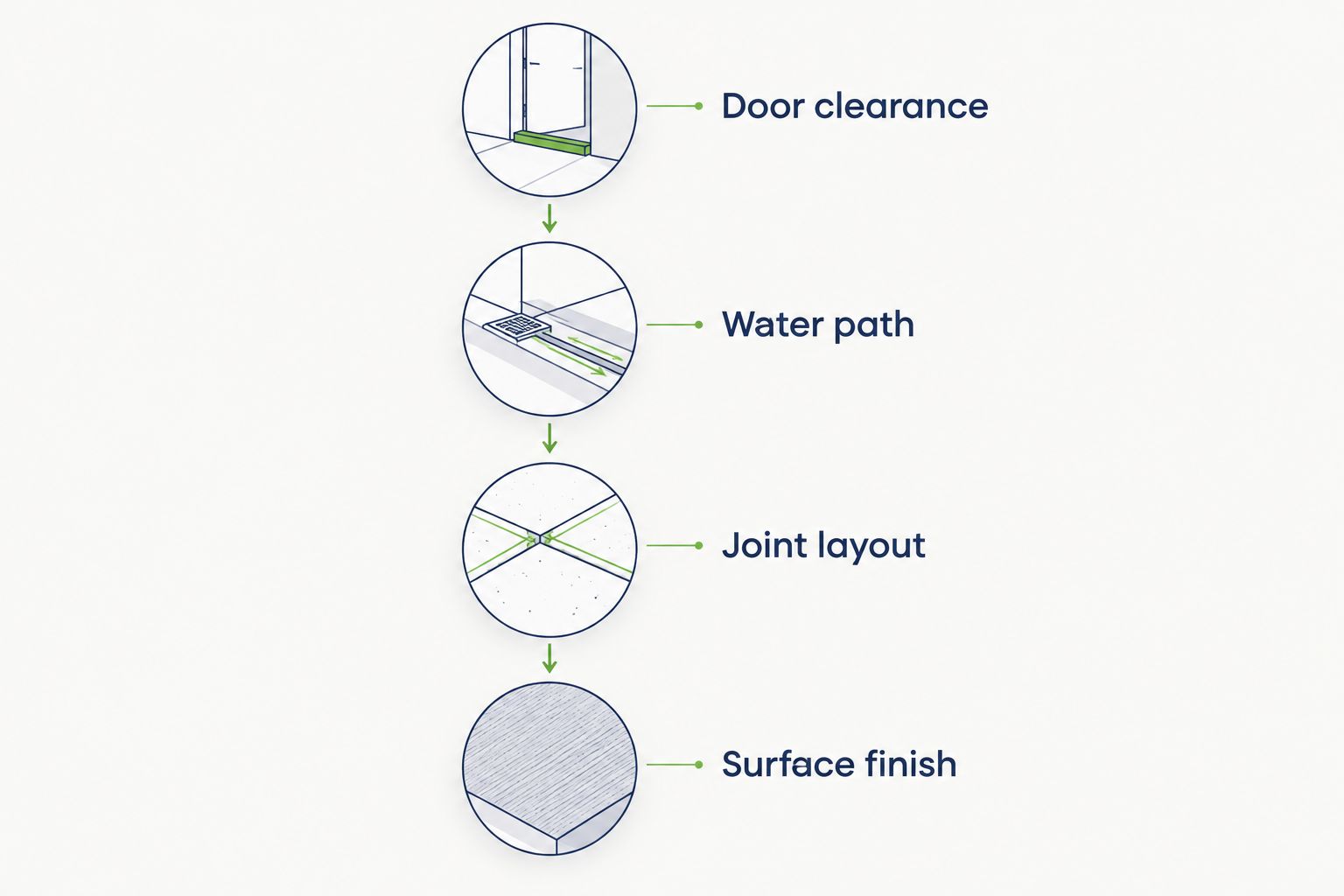
For a 2026 patio project, start with the house threshold and work outward. Identify existing low spots, downspout discharge, nearby slabs, and the intended drainage outlet. Adding a patio must not mean covering a drainage route without resolving where that water will go.
A commonly used preliminary drainage slope for exterior concrete flatwork is a 1/4-inch fall per foot, which equals a 1-inch drop across 4 feet. The actual design must account for the site, door clearances, accessibility requirements, and applicable local rules; that planning example is not a site-specific specification.
- Door clearance: Account for the relationship between the slab and nearby thresholds.
- Water path: Show where runoff leaves the patio and what receives it.
- Joint layout: Coordinate crack-control joints with corners, shapes, and decorative lines.
- Surface finish: Select texture and any sealer after considering wet use and cleaning.
Bring photographs of the yard and any standing water to the project discussion. Green Hammer Concrete provides concrete patio construction and repair in Palm Bay and Brevard County; explain whether you need a new patio, an extension, or attention to an existing slab.
How these designs rank
This 2026 ranking prioritizes everyday use, manageable surface detail, and clear maintenance expectations. Broom-finished concrete takes the default position because it provides a straightforward textured surface; the other options earn distinct places for pattern, geometry, color, or aggregate character.
The ranking compares design choices, not measured performance from a product test. Actual workmanship, base preparation, drainage, joints, and curing remain separate decisions that a finish name cannot settle.
Which concrete patio design should you choose?
Choose broom-finished concrete if you are undecided. Add scored lines if you want a simple geometric layout, or integral color if coordinating with the house matters more than creating a pattern.
Choose stamped concrete when the patio should be a decorative focal point and you accept the additional attention to recesses and sealers. Choose exposed aggregate only after confirming that its texture suits the people using the space.
Before approving a 2026 proposal, ask for the following in writing:
- The patio footprint and intended use.
- Base preparation and the specified slab construction.
- Drainage direction and treatment of existing low spots.
- Joint locations, finish, and any sealer.
- Applicable permit responsibilities and instructions for curing and use.
A finish description alone is not a complete patio scope. You need to know what supports the slab and how the completed surface handles water.
FAQ
What's the best concrete patio design for a Florida backyard?
Broom-finished concrete is the default recommendation for an everyday Florida backyard patio. It provides a straightforward textured surface without deep decorative recesses; drainage, joints, and the final finish still need a site-specific plan.
Is stamped concrete better than broom-finished concrete for a patio?
Stamped concrete is better for a decorative focal point, while broom-finished concrete suits a simpler everyday patio. Compare pattern depth, cleaning needs, and the proposed sealer before choosing.
Can I combine colored concrete with a broom finish?
Yes, integral color can be combined with a broom finish. Color determines appearance, while the broom finish supplies texture; neither replaces drainage planning or crack-control joints.
Does scoring stop a concrete patio from cracking?
Decorative scoring does not guarantee that a concrete patio will stay crack-free. Contraction joints must be planned for crack control, and shallow decorative lines do not automatically perform that function.
Is exposed aggregate comfortable for walking barefoot?
Barefoot comfort depends on the aggregate and how much of it is exposed. Assess a representative sample because coarse stones or uneven exposure can feel uncomfortable.
How do I choose a concrete patio finish near a back door?
Choose the finish after resolving threshold clearance, drainage, and the walking route. Then compare texture, cleaning requirements, and any sealer under the conditions in which you will use the patio.
Who installs or repairs concrete patios in Palm Bay?
Green Hammer Concrete provides concrete patio construction and repair for residential and commercial property owners in Palm Bay and Brevard County. Describe the existing surface, drainage concerns, and intended use when discussing the project.
One last thing
Put your patio furniture on the layout before you approve the outline. Mark the table, pull the chairs back, and check the route between the door and the yard. A decorative border cannot fix a patio that leaves you walking through the seating area every time you step outside.