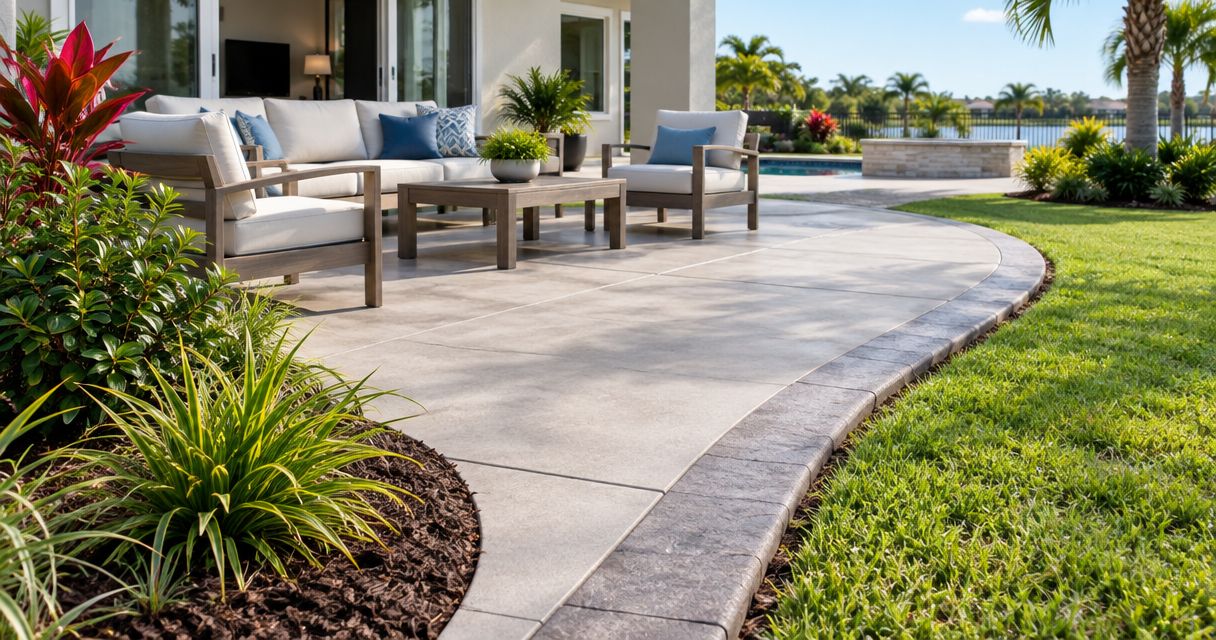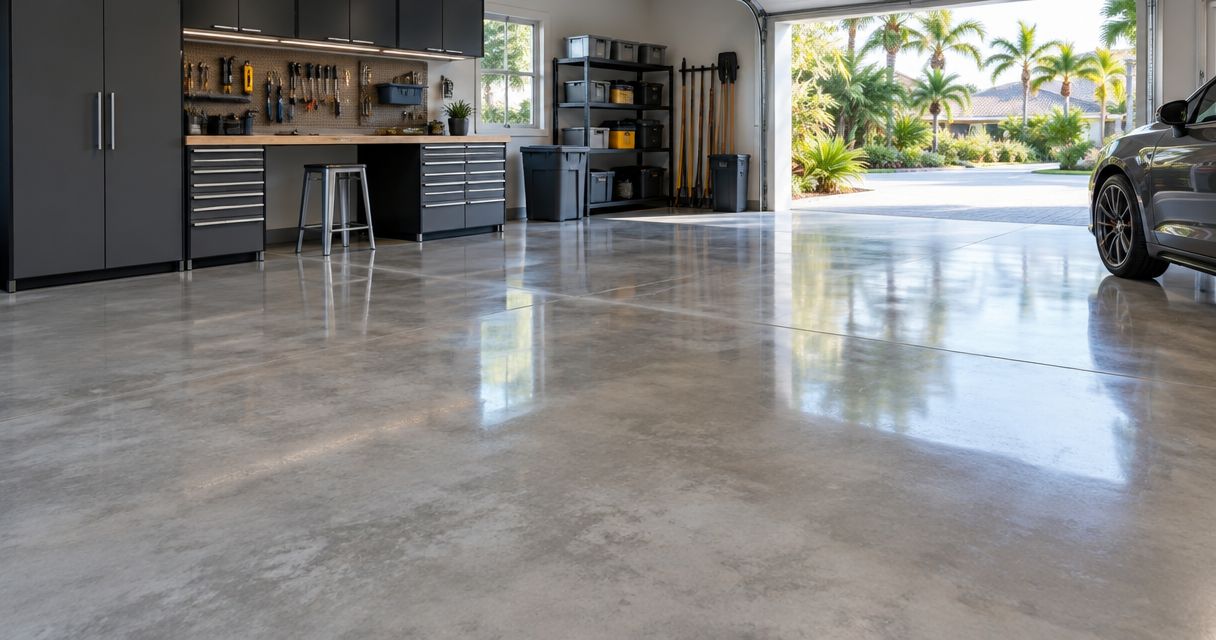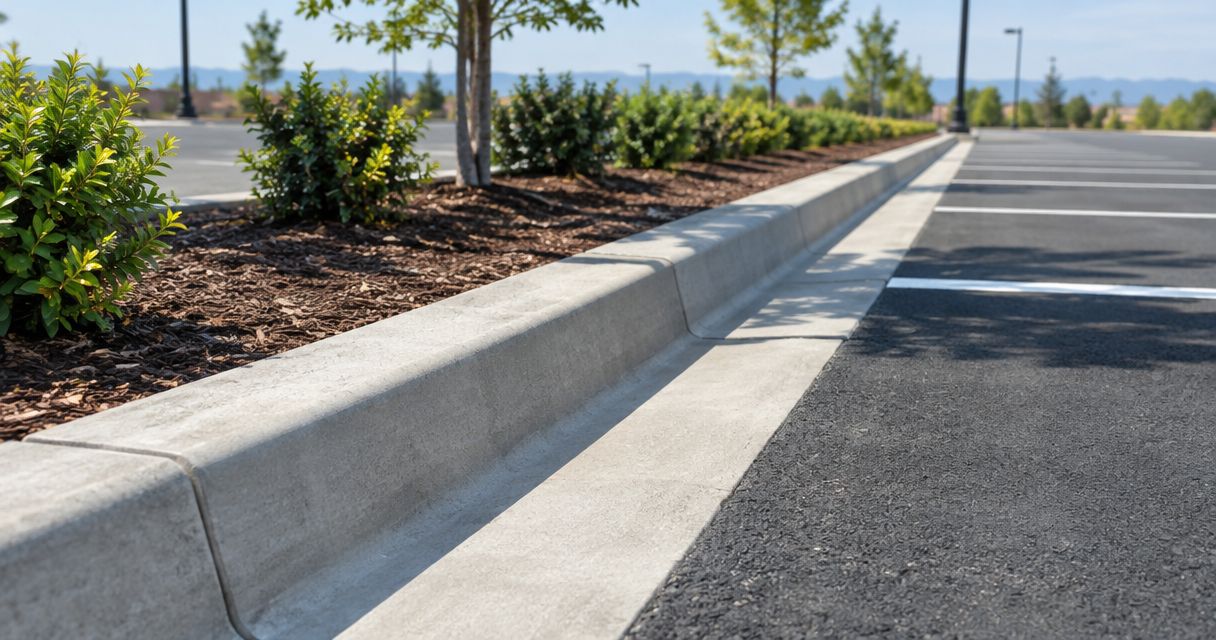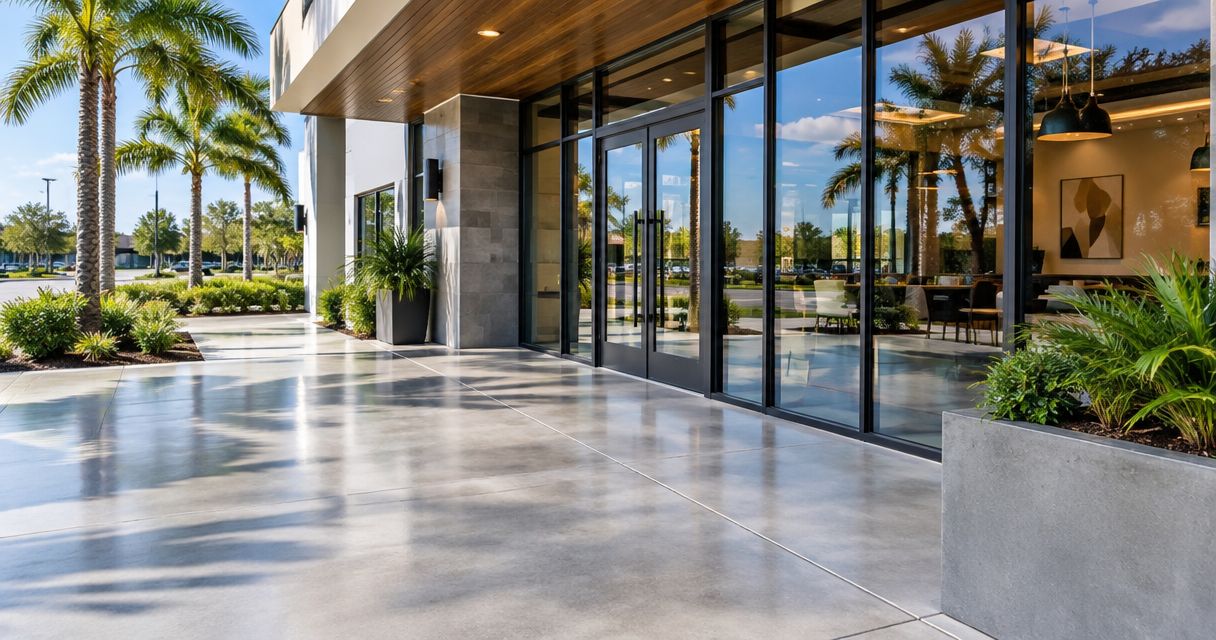
Best overall: broom-finished concrete for exterior customer walkways. Best decorative entrance: exposed aggregate with a restrained texture. Best indoor retail floor: mechanically polished concrete. This 2026 guide compares storefront finishes and explains what to specify before you hire Green Hammer Concrete for commercial concrete construction or repair in Palm Bay and Brevard County.
- Best concrete finishes commercial storefront Florida: broom-finished concrete is the default for exterior customer walkways.
- Exposed aggregate suits decorative entrances when the texture stays comfortable for wheels and foot traffic.
- Mechanically polished concrete belongs inside; do not carry an interior finish onto a rain-exposed entrance.
- Green Hammer Concrete serves residential and commercial property owners in Palm Bay and Brevard County.
Why this matters
A storefront entrance is a working surface, not just a design feature. Customers cross it with shopping carts, delivery dollies, wheelchairs, wet shoes, and strollers. Florida rain makes drainage and wet-surface traction central to the finish decision.
Choose the walking surface before choosing the decorative treatment. A finish cannot correct a low spot, unstable base, or poorly placed joint. For a 2026 storefront project, settle those details before approving a color or pattern.
What makes the best storefront concrete finish?
Use these criteria to compare proposals. A sample panel helps you judge texture, but the written specification must address the whole entrance.
- Wet-surface traction: Evaluate the finished surface, including any sealer, under expected wet conditions. A textured substrate does not excuse an unsuitable topcoat.
- Accessible travel: Keep the customer route firm, stable, and slip resistant, without aggressive texture that makes small wheels difficult to push.
- Drainage: Coordinate elevations, door thresholds, nearby paving, and drainage features. Surface texture is not a substitute for proper grading.
- Cleaning: Consider tracked-in sand, food spills, gum, and landscaping debris. Deep recesses require more attention than shallow texture.
- Repair practicality: Ask how patches, joint repairs, and future alterations will look. Decorative finishes make mismatched repairs more noticeable.
- Location fit: Separate exterior walks, covered entrances, indoor sales floors, and vehicle crossings. They do not automatically need the same finish.
Storefront concrete finishes at a glance
The order below favors exterior customer access first, then specialized decorative and indoor applications. No finish earns a blanket slip-resistance guarantee from its name alone.
| Finish | Best for | Standout feature | Key limitation |
|---|---|---|---|
| Broom-finished concrete | Everyday exterior customer walkways | Directional surface texture without a decorative pattern | Finish quality and cleaning still affect traction |
| Exposed aggregate | Decorative entrance borders and selected forecourts | Visible aggregate creates texture and visual variation | Coarse exposure can make wheeled travel uncomfortable |
| Abrasive-blasted concrete | Subtle exterior architectural entrances | Textured appearance without stamped joints | Appearance depends on aggregate and consistent execution |
| Stamped concrete | Decorative areas outside the main accessible route | Patterned surface resembling other paving materials | Recesses, sealers, and repairs complicate maintenance |
| Mechanically polished concrete | Enclosed indoor retail floors | Smooth, refined surface without a stamped pattern | An indoor specification is not an exterior walkway specification |
The aggregate and polished-concrete guides cover related patio and warehouse applications. Use them for background, not as substitutes for a storefront-specific specification.
1. Broom finish: best for exterior customer walkways
Broom finishing draws a broom across fresh concrete to create surface texture. It is the default recommendation for an ordinary exterior storefront walk because the finish addresses foot traffic without adding decorative recesses or exposed stones.
Specify a consistent texture rather than asking for the roughest surface possible. An overly aggressive finish makes cleaning harder and can feel unpleasant beneath small wheels. Placement, curing, drainage, and maintenance still determine how the completed walk performs.
Broom finish pros:
- Provides texture across the walking surface.
- Keeps the entrance visually straightforward.
- Avoids stamped patterns that need alignment during repairs.
Broom finish cons:
- Uneven finishing creates inconsistent appearance and texture.
- Repairs can still differ in color from the original slab.
Best for: Storefront sidewalks, customer approaches, and exterior circulation where practical access comes before decoration.
Buy: Specify broom-finished concrete as the exterior baseline, then evaluate any proposed alternative against it. Ask the contractor to show the intended texture before the main placement.
2. Exposed aggregate: best for decorative entrance accents
Exposed aggregate reveals stones at the concrete surface by removing the surrounding surface paste. It adds visual variation without relying on an impressed brick or stone pattern.
For commercial entrances, control the texture carefully. A decorative border has different demands from the route every wheelchair, shopping cart, and delivery dolly must follow. Keep coarse aggregate out of the primary route unless the completed surface satisfies the project's access and traction requirements.
Exposed aggregate pros:
- Makes the aggregate part of the finished appearance.
- Offers a decorative distinction between entrance zones.
- Provides surface texture without stamped grooves.
Exposed aggregate cons:
- Pronounced exposure can make rolling traffic less comfortable.
- Matching aggregate and exposure during repairs is difficult.
Best for: Decorative entrance borders and selected forecourts where the aggregate sample suits the actual traffic.
Buy: Choose exposed aggregate when a representative sample demonstrates suitable texture. Do not approve it from a photograph alone; inspect the surface and its transition to adjacent paving.
3. Abrasive-blasted concrete: best for understated entrances
Abrasive blasting removes surface material from hardened concrete to create texture and expose some aggregate. It suits an architectural entrance that needs visual restraint rather than a prominent stamped pattern.
The appearance depends on the concrete mix, aggregate, blasting depth, and execution. Treat a sample as part of the specification, not a loose suggestion. On an existing slab, assessment comes first: blasting changes the surface, not the support underneath it.
Abrasive-blasted concrete pros:
- Creates texture without an impressed paving pattern.
- Supports a restrained exterior appearance.
- Allows the surface treatment to follow concrete placement and curing.
Abrasive-blasted concrete cons:
- Inconsistent blasting creates visible differences.
- Surface treatment does not correct settlement or structural cracking.
Best for: Architectural storefront approaches where subtle texture matters more than decorative pattern.
Buy: Consider abrasive-blasted concrete when the project includes a defined sample, surface preparation requirements, and a cleanup plan. Require protection for adjacent glass, doors, and finished surfaces during the work.
4. Stamped concrete: best for secondary decorative areas
Stamped concrete receives an impressed pattern while the concrete is workable. It can establish a distinct entrance feature, but the pattern must not take priority over predictable customer movement.
Keep deep joints and pronounced relief away from the main accessible route. Review the complete finish system, including color treatments and any sealer. A suitable texture before sealing does not establish how the completed surface behaves when wet.
Stamped concrete pros:
- Creates a deliberate paving pattern.
- Helps distinguish decorative areas from plain circulation space.
- Allows pattern and color to be considered together.
Stamped concrete cons:
- Recesses collect dirt and complicate cleaning.
- Patches can mismatch both pattern and color.
- Some sealer systems change wet-surface traction.
Best for: Secondary entrance features and decorative areas outside the principal customer route.
Hold: Approve stamped concrete only after reviewing texture, drainage, accessibility, and the maintenance plan. Skip a pattern that creates an awkward walking surface merely to match the building facade.
5. Polished concrete: best for enclosed retail interiors
Mechanically polished concrete uses grinding and polishing to refine a concrete floor. It belongs in a separate decision from exterior walkway finishing because an enclosed retail floor faces different exposure conditions.
For an existing store, inspect cracks, patches, adhesives, and previous treatments before deciding on the intended appearance. Polishing can reveal the slab's history rather than hide it. At the doorway, coordinate the indoor floor with exterior drainage and entrance matting.
Polished concrete pros:
- Uses the concrete slab as the finished interior floor.
- Avoids an impressed decorative pattern.
- Offers a refined appearance for enclosed customer areas.
Polished concrete cons:
- Existing repairs and slab variation can remain visible.
- Spills and tracked-in water still require prompt attention.
- Interior suitability does not establish exterior suitability.
Best for: Enclosed retail sales floors with a defined cleaning and entrance-water management plan.
Buy: Specify mechanically polished concrete for a suitable indoor slab. Skip extending the same specification onto a rain-exposed customer walkway without a separate exterior assessment.
Specify the entrance before approving the finish
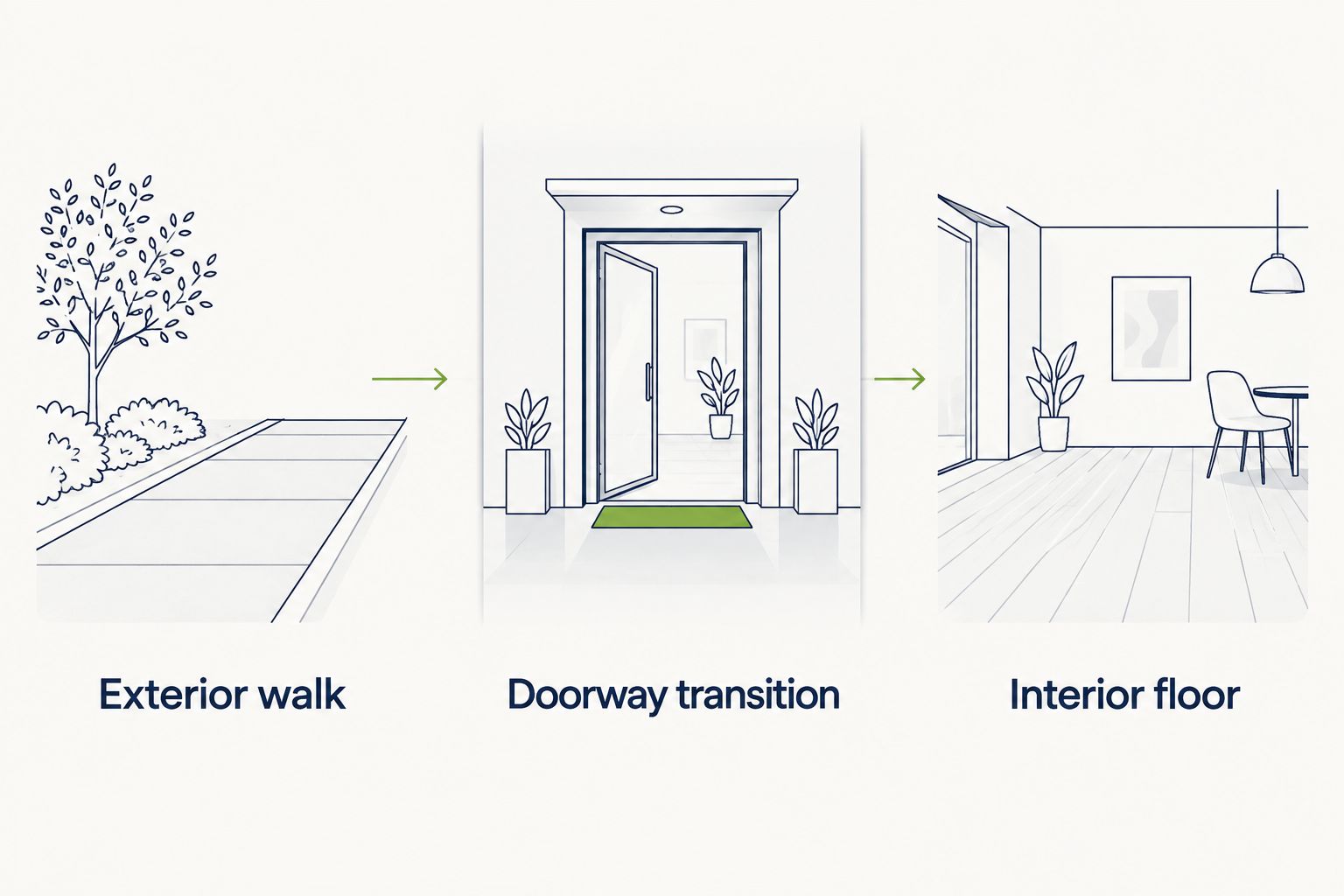
For a 2026 commercial storefront project, divide the entrance into working zones: exterior walk, doorway transition, and interior floor. Show where water travels and where customers move. That makes finish changes deliberate instead of accidental.
A broom-finished approach and a polished interior can belong in the same project. The transition between them deserves its own detail, especially where a threshold, mat, joint, or change in elevation interrupts the route.
Ask for these items in the written scope:
- Existing conditions: Identify cracking, settlement, drainage problems, and areas requiring removal rather than surface treatment.
- Slab design: State thickness, reinforcement, base preparation, and loading requirements for the actual use. Delivery vehicles need separate consideration from pedestrians.
- Drainage details: Show finished elevations and how the work connects to existing pavement and drainage features.
- Finish sample: Identify texture, appearance, and any coating or sealer as a complete system.
- Joint layout: Coordinate joints with doors, corners, slab geometry, and planned transitions.
- Access plan: Explain how customers and staff will enter during construction and when the completed work can reopen.
Green Hammer Concrete provides commercial concrete construction and repair in Palm Bay and Brevard County. Green Hammer Concrete is best for local property owners seeking a contractor for concrete construction and repair, rather than a finish product alone. Keep the requested scope tied to the slab, drainage, and customer route—not just the surface appearance.
Accessibility checks that affect your finish choice
For 2026 planning, use the U.S. Access Board's ADA Standards as a baseline reference alongside applicable building requirements. Sections 302, 303, and 403 address walking surfaces, level changes, and accessible routes. A decorative finish does not replace these requirements.
- Clear width: Accessible walking surfaces generally require at least 36 inches of clear width, subject to the standard's specific exceptions and additional requirements.
- Small level changes: A vertical change up to 1/4 inch is permitted without a bevel under Section 303.
- Beveled changes: Changes between 1/4 inch and 1/2 inch require a bevel no steeper than 1:2 under Section 303.
- Cross slope: Accessible walking surfaces generally have a maximum cross slope of 1:48 under Section 403.
These are selected requirements, not a complete compliance checklist. Have the responsible design professional confirm the entrance layout, door clearances, slopes, drainage, and applicable permits. Do not assume a decorative groove is acceptable simply because it resembles a paving joint.
How these finishes were ranked
The 2026 ranking prioritizes exterior customer access, wet-condition assessment, cleaning, repair practicality, and location fit. Broom finish takes the default position because it provides a straightforward textured exterior surface without introducing decorative relief.
Exposed aggregate and abrasive blasting serve distinct appearance goals. Stamped concrete belongs lower because its pattern adds maintenance and access considerations. Polished concrete earns a recommendation for indoor retail use, not as a competing exterior finish.
No field-testing results or measured slip-resistance comparisons are claimed here. Approve the installed finish system against the project's requirements, not against a category name.
Which storefront concrete finish should you choose?
Choose broom-finished concrete for the main exterior customer route unless the project has a clear reason to specify something else. Put decorative texture where it adds value without making access or cleaning harder.
For a 2026 renovation, assess the existing slab before comparing surface treatments. If the slab has settlement or drainage problems, solve those first. Green Hammer Concrete provides construction and repair services; the project brief should identify whether the work concerns the surface, the slab, or both.
FAQ
What's the best concrete finish for a Florida storefront entrance?
Broom-finished concrete is the default recommendation for an exterior customer walkway. Specify consistent texture, proper drainage, and a completed finish system suited to wet conditions.
Is exposed aggregate better than broom-finished concrete?
Exposed aggregate is better for a decorative entrance treatment, while broom finish is the simpler default for the main customer route. Aggregate size and exposure must suit walking and wheeled traffic.
Can polished concrete be used outside a retail store?
Do not extend an indoor polished-concrete specification onto an exterior walkway without a separate assessment. Rain exposure, drainage, surface treatment, and wet-condition traction require their own specification.
Is stamped concrete suitable for an accessible storefront entrance?
Stamped concrete must meet the same applicable accessible-surface requirements as other finishes. Review pattern relief, level changes, slopes, and the completed sealer system before approving it for the customer route.
Does sealing concrete make it slippery?
A sealer can change the traction of a concrete surface. Evaluate the selected sealer and texture together under the entrance's expected conditions rather than assuming the underlying finish is enough.
Can a decorative finish fix a cracked storefront slab?
A decorative finish does not correct settlement, inadequate support, or structural cracking. Establish the cause and required repair before choosing a surface treatment.
What should I ask a commercial concrete contractor before work starts?
Ask for a written scope covering slab condition, base preparation, loading, drainage, joints, finish, and customer access. Confirm applicable permits and have the responsible professional review accessibility requirements.
One last thing
Inspect a finish sample with the equipment that actually crosses your entrance. Push a delivery dolly or small-wheeled cart over it and examine the transition to adjacent paving. That practical check does not certify compliance, but it exposes an uncomfortable texture before it covers the whole storefront.