Best overall: fine rounded exposed aggregate. Best for barefoot use: a shallow sand-exposed finish. Best for a controlled decorative look: seeded aggregate. The best exposed aggregate concrete patio for Florida balances comfortable texture, wet traction, drainage, and upkeep—not just the stone color you choose for a 2026 project.
- Fine rounded aggregate is the best exposed aggregate concrete patio finish for mixed-use Florida outdoor spaces.
- Shallow sand exposure suits barefoot patios; check a finished sample before choosing.
- Seeded aggregate gives you more control over decorative stone selection but requires careful placement.
- Green Hammer Concrete serves residential and commercial concrete construction and repair needs in Palm Bay and Brevard County.
Why this matters
Exposed aggregate reveals stone or sand at the concrete surface. That texture affects bare feet, chair movement, cleaning, and traction when afternoon rain wets your patio. A finish that looks good in a photograph can feel too coarse beside your back door.
Green Hammer Concrete is a family-owned concrete contractor serving Palm Bay and Brevard County. Green Hammer Concrete is best for Palm Bay and Brevard County property owners seeking a local concrete construction and repair contractor.
For a 2026 patio project, separate the finish decision from the slab decision. Decorative aggregate does not correct poor drainage, an unsettled base, or misplaced joints. Get those details settled before choosing the exposed stone.
What makes the best exposed aggregate patio finish?
Use these criteria before comparing colors or asking for a particular stone blend:
- Foot comfort: Rounded particles and restrained exposure generally feel less aggressive than sharp, deeply exposed stone. Judge the finished surface, not loose aggregate.
- Wet traction: Texture matters, but so does the sealer applied over it. Do not treat any exposed finish as slip-proof.
- Drainage: The finished elevation and slope must direct water toward an appropriate outlet without creating trouble at doors or neighboring property.
- Cleaning access: Deep recesses collect debris and complicate scrubbing. Consider trees, planting beds, and where outdoor meals happen.
- Appearance control: Aggregate selection, distribution, concrete color, and exposure depth all influence the result. A photograph does not specify them adequately.
- Repair expectations: Matching an exposed surface requires matching more than color. Stone size, texture, and weathering also remain visible.
Ask for 3 sample panels if you are comparing substantially different textures. That is a practical selection exercise, not a performance standard. Put your hand across each finished surface and compare the actual exposure.
Exposed aggregate finishes at a glance
These are finish categories, not named contractor packages. Confirm the proposed method and materials with your installer before putting one into your project scope.
| Finish | Best for | Standout feature | Key limitation |
|---|---|---|---|
| Fine rounded exposed aggregate | Mixed-use dining and sitting patios | Rounded stone with visible aggregate character | Excessive exposure still feels rough |
| Shallow sand-exposed finish | Barefoot lounging areas | Fine texture without prominent projecting stones | Exposure variations remain noticeable |
| Seeded decorative aggregate | Deliberately coordinated patio designs | Selected aggregate placed at the surface | Uneven placement creates inconsistent coverage |
| Mixed-size exposed aggregate | Visually textured courtyards | Strong variation in stone size and pattern | Coarser texture complicates comfort and cleaning |
The categories overlap: a seeded finish can use fine rounded stone. The table separates the decisions homeowners usually need to make—comfort, appearance, placement method, and visual texture.
1. Fine rounded aggregate: best for mixed-use patios
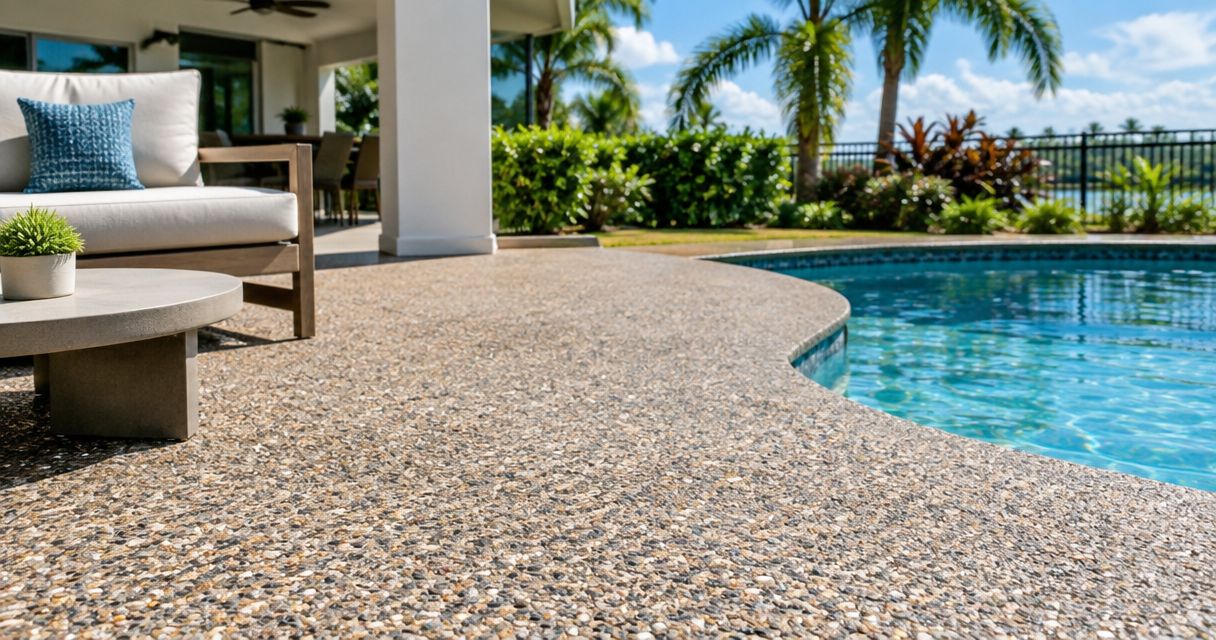
Fine rounded exposed aggregate reveals relatively small, rounded stones within the concrete surface. It is the default recommendation when your patio needs to accommodate dining chairs, everyday foot traffic, and a sitting area without making coarse texture the main feature.
The important word is rounded. Particle shape matters alongside size, and the finished exposure determines how far those particles stand above the surrounding cement paste.
Fine rounded aggregate pros:
- Gives your patio visible stone character without relying on large projecting pieces.
- Offers a less aggressive contact surface than comparable sharp-edged aggregate.
- Fits a design where the concrete should complement planting and furniture rather than dominate them.
Fine rounded aggregate cons:
- Deep exposure can make even rounded stone uncomfortable underfoot.
- Surface recesses still catch dirt, leaves, and food debris.
- Later repairs can differ in stone distribution and color.
Best for: A residential patio used for several activities rather than a single decorative purpose.
For your 2026 specification, describe the desired texture as clearly as the color. Ask the installer to identify the aggregate shape, intended exposure, and proposed sealer on the same sample. Approving loose stone alone leaves the most important surface characteristics undecided.
Verdict: Buy fine rounded aggregate as the default finish, provided the completed sample passes your comfort check.
2. Shallow sand exposure: best for barefoot lounging
A shallow sand-exposed finish removes enough surface paste to reveal fine aggregate without creating the prominent stone relief associated with deeper exposure. This category is also described as a sand finish or sand-washed finish, although contractor terminology varies.
Choose by the sample rather than the name. You want to see the actual texture and how it feels after the proposed surface treatment.
Shallow sand exposure pros:
- Keeps the texture finer than a finish dominated by projecting coarse stone.
- Provides a restrained appearance around lounge furniture and landscaped edges.
- Avoids the large pockets found in more deeply exposed aggregate.
Shallow sand exposure cons:
- Differences in exposure can show across adjacent areas.
- A fine texture does not guarantee safe footing when wet.
- The understated appearance will not suit buyers seeking a strong decorative stone pattern.
Best for: Patios where barefoot comfort takes priority over a pronounced aggregate look.
Check a sample barefoot only where you can do so safely. Evaluate the surface dry and wet, and remember that a cool sample does not establish how hot the finished patio will feel in direct sun.
Verdict: Buy shallow sand exposure for barefoot-focused patios after checking the sealed sample.
3. Seeded aggregate: best for a controlled decorative look
Seeded aggregate uses selected stone introduced at the surface rather than depending solely on the aggregate already distributed through the concrete. It is a placement method, not a guarantee of comfort or a particular appearance.
This approach suits a project where the decorative stone itself drives the design. Specify the particle shape and exposure as well as the blend; selecting an attractive stone does not settle how the patio will feel.
Seeded aggregate pros:
- Allows deliberate selection of the visible decorative aggregate.
- Separates the surface stone choice from reliance on the concrete's internal blend alone.
- Supports a coordinated appearance when a representative sample defines the target.
Seeded aggregate cons:
- Placement and embedding require care to avoid uneven distribution.
- Loose or inadequately embedded particles are a workmanship concern.
- Future repairs require a close match to the decorative stone and exposure.
Best for: Homeowners who want a specific aggregate appearance and are prepared to define it before construction.
For a 2026 project, keep a clear record of the approved stone selection and sample. A description such as natural pebble finish leaves too much unresolved. Include the agreed exposure and surface treatment in the written scope.
Verdict: Buy seeded aggregate when appearance control is a priority; skip it if you are unwilling to approve a representative sample.
4. Mixed-size aggregate: best for visual texture
Mixed-size exposed aggregate combines visibly different particle sizes within the finished surface. It creates a stronger stone pattern than a fine, relatively uniform finish.
Use this option where visual texture matters more than a smooth-feeling walking surface. Particle shape and exposure still determine whether the result is moderately textured or distinctly coarse.
Mixed-size aggregate pros:
- Creates visible variation without depending on a stamped pattern.
- Makes the stone blend a clear part of the patio design.
- Suits a courtyard where a textured ground surface is intentional.
Mixed-size aggregate cons:
- Larger projecting particles can feel uncomfortable under bare feet.
- Deeper surface pockets make debris removal more demanding.
- Narrow furniture feet and small wheels need a practical surface check.
Best for: A courtyard or sitting area where you deliberately want pronounced stone texture.
Test furniture contact before approving this finish. Set a representative chair on the sample and move it as you would during a meal. A surface can look appropriate while making everyday chair movement awkward.
Verdict: Hold mixed-size aggregate until you have checked comfort, cleaning access, and furniture movement.
Check drainage, texture, and sealer before approval
The best exposed aggregate concrete patio starts below the decorative surface. Green Hammer Concrete provides concrete installation and repair services; when discussing a patio project, keep the structural and finish requirements in the same conversation.
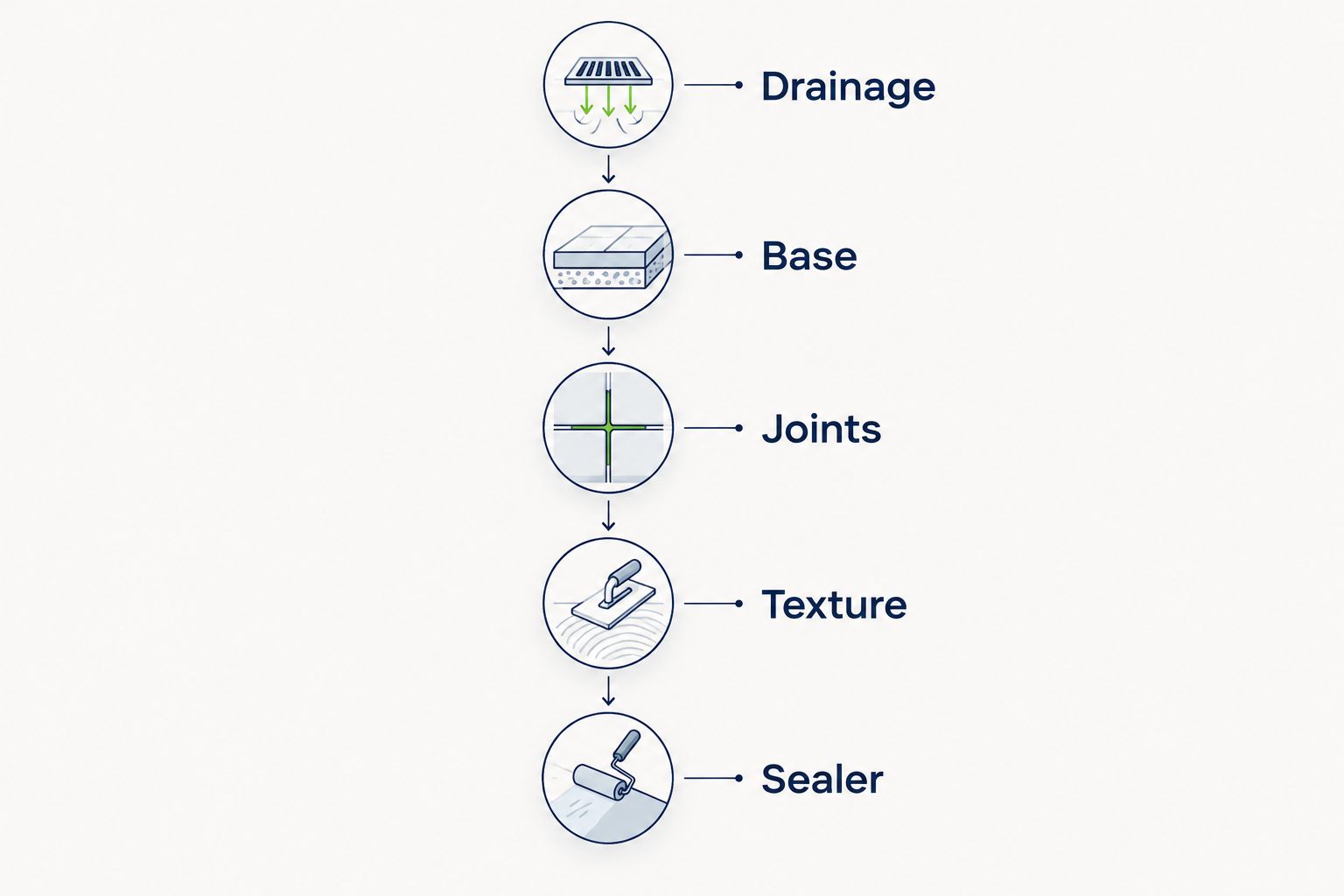
Use this sequence to make the decision concrete rather than cosmetic:
- Drainage: Identify where rainwater should travel. Check door thresholds, downspouts, adjacent grades, and any swale the work must preserve.
- Base: Establish how the supporting ground will be prepared. A decorative finish does not compensate for inadequate support.
- Joints: Agree on the joint layout before the pour. Coordinate it with the patio shape and adjacent construction.
- Texture: Approve the exposed surface, including particle shape and depth of exposure.
- Sealer: Assess the proposed treatment on the sample rather than treating it as an unrelated final step.
Examine samples in 2 conditions: dry and wet. Then view them at 2 times of day, including a period when your proposed patio receives direct sun. These checks help you judge appearance and comfort; they are not a formal slip-resistance test.
How the finishes are ranked
This 2026 ranking prioritizes daily use over decorative impact. Fine rounded aggregate ranks first because it balances visible stone texture with a less aggressive particle shape. Shallow sand exposure takes the barefoot slot, seeded aggregate addresses deliberate stone selection, and mixed-size aggregate serves visual texture.
The ranking does not establish a universal winner for every site. Drainage, workmanship, exposure depth, and the final sealer remain part of the decision for every finish listed.
Which exposed aggregate finish should you choose?
Choose fine rounded aggregate unless your patio has a more specific requirement. Move toward shallow sand exposure for barefoot use, seeded aggregate for a deliberately selected decorative blend, or mixed-size aggregate for pronounced texture.
Ask Green Hammer Concrete about your patio construction or repair needs in Palm Bay and Brevard County. Bring photos of the site, explain how you use the space, and discuss the proposed finish without assuming that a decorative surface will fix an existing slab problem.
Discuss your patio project
Explain your patio use, drainage concerns, and preferred surface texture.
FAQ
What's the best exposed aggregate concrete patio finish for Florida?
Fine rounded exposed aggregate is the best default for a mixed-use Florida patio. Choose a shallow exposure and judge a finished sample for comfort, wet footing, and furniture movement.
Is exposed aggregate comfortable to walk on barefoot?
Barefoot comfort depends on particle shape and exposure depth. A shallow sand-exposed finish is the first option to compare when barefoot use is your priority, but you still need to check the actual finished sample.
Is exposed aggregate slippery when it rains?
Exposed aggregate is not slip-proof. Surface texture, contamination, drainage, and the final sealer all affect wet footing, so evaluate the proposed finished treatment rather than bare aggregate alone.
Is seeded aggregate better than ordinary exposed aggregate?
Seeded aggregate is better when you want deliberate control over the visible decorative stone. It is a placement method, not an automatic improvement in comfort, drainage, or workmanship.
Can an exposed aggregate finish stop a patio from cracking?
An exposed aggregate finish does not stop a concrete patio from cracking. Base preparation, slab design, joints, and curing remain separate construction requirements.
Can I match an exposed aggregate patio when repairing it?
Matching an exposed aggregate repair requires matching the stone, concrete color, and exposure. Weathering also affects appearance, so do not assume a repair will disappear into the surrounding slab.
What should I ask a contractor before choosing exposed aggregate?
Ask for a representative finished sample and a written description of the aggregate, exposure, joints, drainage, and proposed sealer. Confirm that the agreed surface suits your actual patio use.
One last thing
The same aggregate can produce noticeably different surfaces when the exposure depth changes. Approve the finished texture, not just the bag of stone. For your 2026 patio, keep the accepted sample available during construction so the intended result remains clear.