Best overall for an approved residential driveway crossing: dual-wall HDPE. Best for engineered heavy-load crossings: reinforced concrete. Best for a lightweight metal installation: corrugated aluminum. Best for a project specifying protected metal: coated corrugated steel. This 2026 guide compares the best culvert pipe materials Florida drainage projects use, with approval, soil support and corrosion treated as deciding factors.
- Best culvert pipe materials Florida drainage: start with approved dual-wall HDPE for a residential driveway crossing.
- Reinforced concrete suits engineered heavy-load crossings, but lifting and foundation preparation demand attention.
- Aluminum and coated steel require site-specific corrosion checks; neither is a universal Florida choice.
- Green Hammer Concrete serves Palm Bay and Brevard County owners needing concrete driveway construction or repair.
Why this matters
A driveway culvert carries ditch or swale flow beneath your entrance. The wrong material, elevation or installation can leave you with standing water, eroded shoulders or a settling driveway. A stronger pipe does not correct an undersized opening or an outlet set too high.
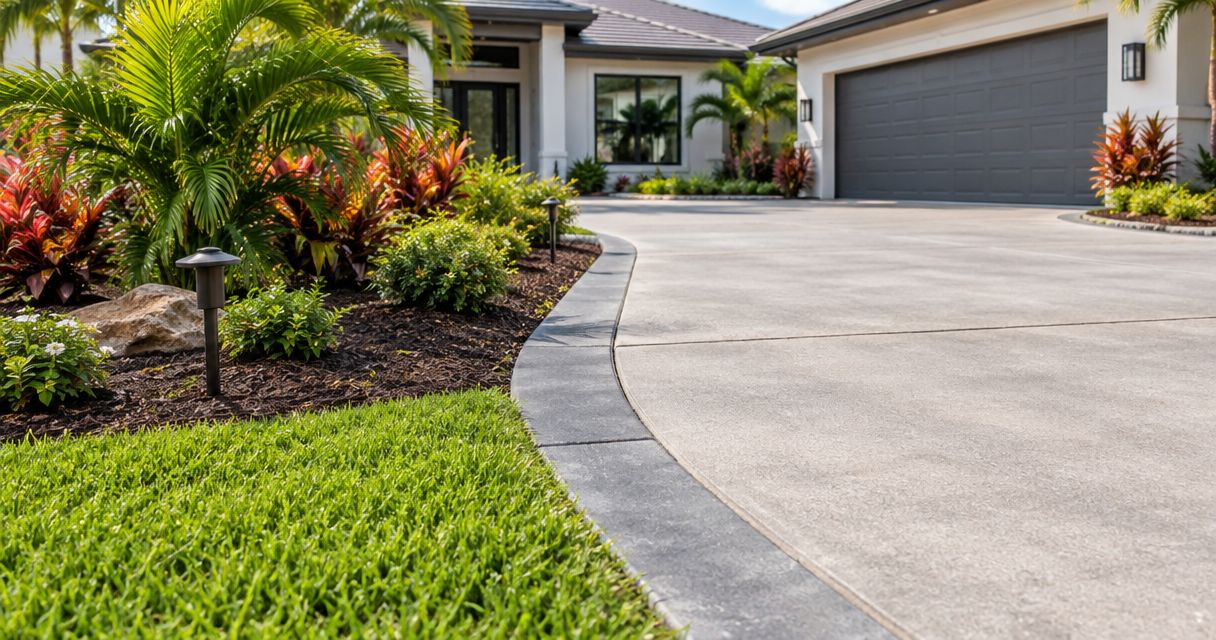
Green Hammer Concrete is a family-owned concrete contractor serving residential and commercial property owners in Palm Bay and Brevard County. If your concrete driveway project crosses a drainage swale, settle the drainage requirements before choosing the driveway layout or finish.
No culvert material wins without the right approval, hydraulic sizing and installation. The ranking below is a selection guide, not permission to substitute one pipe for another on an approved plan.
What makes the best culvert pipe material?
Use these criteria for a 2026 project before comparing pipe types:
- Local acceptance: Identify who controls the road, right-of-way and drainage connection. Confirm the permitted material and pipe configuration.
- Hydraulic performance: Check the opening, slope, inlet and outlet together. Nominal diameter alone does not establish drainage capacity.
- Structural design: Match the pipe system to vehicle loads, burial depth and available cover beneath the driveway.
- Corrosion resistance: Evaluate soil and water conditions, especially where metal pipe is under consideration.
- Installation requirements: Compare bedding, side support, joint assembly and equipment access—not just the pipe itself.
- Maintenance access: Leave practical access to inspect and clear both ends without dismantling the driveway.
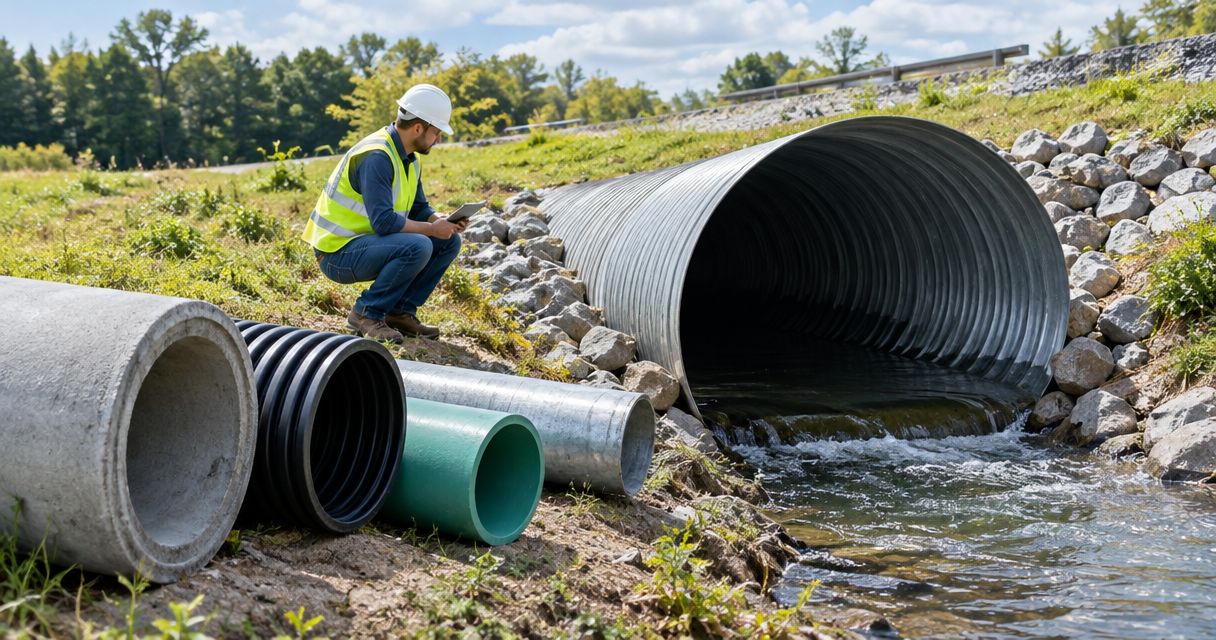
Florida culvert materials at a glance
These are material families, not interchangeable products. A smooth-interior plastic pipe and a fully corrugated pipe can behave differently even when their nominal diameters match.
| Rank and material | Best for | Standout characteristic | Key limitation |
|---|---|---|---|
| 1. Dual-wall HDPE | Approved residential driveway crossings | Lightweight plastic construction with a smooth interior | Depends on correct side support and required cover |
| 2. Reinforced concrete pipe | Engineered heavy-load crossings | Rigid pipe with specified structural classes | Heavy sections require lifting equipment and sound foundation support |
| 3. Corrugated aluminum pipe | Approved sites needing lightweight metal | Lighter handling than comparable steel pipe | Soil and water chemistry still govern suitability |
| 4. Coated corrugated steel pipe | Projects designed around protected steel | Structural configurations and protective coating options | Coating damage and corrosion need attention |
1. Dual-wall HDPE: best culvert pipe for residential crossings
Dual-wall high-density polyethylene pipe combines a corrugated outer wall with a smooth interior. It is a practical first material to discuss for a residential driveway crossing when the reviewing authority accepts the specific pipe and installation.
HDPE does not rust. But it is a flexible pipe system: the surrounding compacted soil helps it resist loads, so trench preparation and side support are part of its structure.
Dual-wall HDPE pros:
- Lower handling weight than concrete pipe simplifies placement.
- Plastic avoids the rust mechanism that affects steel.
- A smooth interior limits the hydraulic roughness associated with internal corrugations.
Dual-wall HDPE cons:
- Poor haunch support or unsuitable backfill can allow excessive deformation.
- Required cover and loading limits still apply beneath driveways.
- Acceptance depends on the product specification and jurisdiction.
Best for: Homeowners planning an approved residential entrance with enough depth for the specified installation.
For a 2026 driveway project, ask for the pipe designation, installation detail and required cover in the written scope. The label plastic culvert is not enough to identify an acceptable product.
Verdict: Buy only after the exact HDPE pipe and installation detail are accepted for the crossing.
2. Reinforced concrete: best culvert pipe for heavy-load crossings
Reinforced concrete pipe is a rigid drainage product available in specified structural classes. It belongs on the shortlist when an engineered crossing calls for concrete pipe and suitable equipment can reach the excavation.
Its weight is both a handling issue and a construction-planning issue. Foundation preparation, pipe class and bedding must match the design; concrete is not a shortcut around weak ground.
Reinforced concrete pipe pros:
- Structural classes let the designer specify the required pipe strength.
- Rigid sections do not depend on flexible-wall behavior.
- Concrete avoids steel's rust mechanism.
Reinforced concrete pipe cons:
- Heavy sections require lifting equipment and adequate access.
- Differential settlement can affect joints and alignment.
- Aggressive chemical exposure still requires a durability review.
Best for: Commercial entrances and other load-sensitive crossings where the engineer specifies reinforced concrete pipe.
Do not choose concrete merely because trucks use the driveway. The designer must consider the actual loading, foundation and burial conditions together. Plastic and metal systems also have engineered load applications.
Verdict: Buy when the design specifies the pipe class, bedding and joint requirements—not simply because concrete feels stronger.
3. Corrugated aluminum: best culvert pipe for lightweight metal work
Corrugated aluminum pipe offers a metal option with lower handling weight than comparable steel construction. Its corrugated shape provides structural stiffness, while soil support remains an essential part of the installation.
Aluminum forms a protective oxide layer, but that does not make it immune to corrosion. Soil chemistry, water chemistry and contact with dissimilar metals need review before selection.
Corrugated aluminum pipe pros:
- Lower weight helps where equipment access is restricted.
- It avoids the iron-rust mechanism associated with steel.
- Corrugated construction provides structural stiffness.
Corrugated aluminum pipe cons:
- Unsuitable chemical exposure can damage aluminum.
- Abrasive sediment can wear the pipe's interior.
- Internal corrugations must be included in hydraulic calculations.
Best for: An approved crossing where lightweight metal construction fits the design and site chemistry supports aluminum.
A coastal address alone does not prove aluminum is suitable—or unsuitable. Evaluate the actual drainage water and soil rather than selecting a pipe from a general description of Florida weather.
Verdict: Hold until the reviewing authority and designer confirm aluminum's suitability for the exposure.
4. Coated corrugated steel: best for specified protected-metal systems
Corrugated steel pipe uses a shaped metal wall to carry loads as part of a buried pipe system. Galvanizing and other protective coatings help separate the steel from corrosive exposure; the specified protection must match the site.
The coating is not an excuse to ignore soil or water chemistry. Handling damage, exposed cut edges and abrasive flow are details to address during selection and installation.
Coated corrugated steel pipe pros:
- Corrugated steel is an established engineered drainage material.
- Protective coating options address different exposure conditions.
- Metal construction provides structural configurations for varied designs.
Coated corrugated steel pipe cons:
- Steel corrodes when exposure exceeds the protection provided.
- Damaged coatings require attention under the applicable specification.
- Abrasive flow can wear protective surfaces inside the pipe.
Best for: A project with an accepted steel-pipe specification and a documented corrosion-protection approach.
For a 2026 replacement, do not treat an existing steel culvert as proof that another identical pipe is the right choice. Inspect why the old installation failed before repeating its material or configuration.
Verdict: Hold unless the specified coating, exposure assessment and installation requirements are clear.
Size, cover and elevation come before the order
Material selection cannot rescue the wrong drainage layout. Work through these decisions before buying pipe or scheduling concrete.
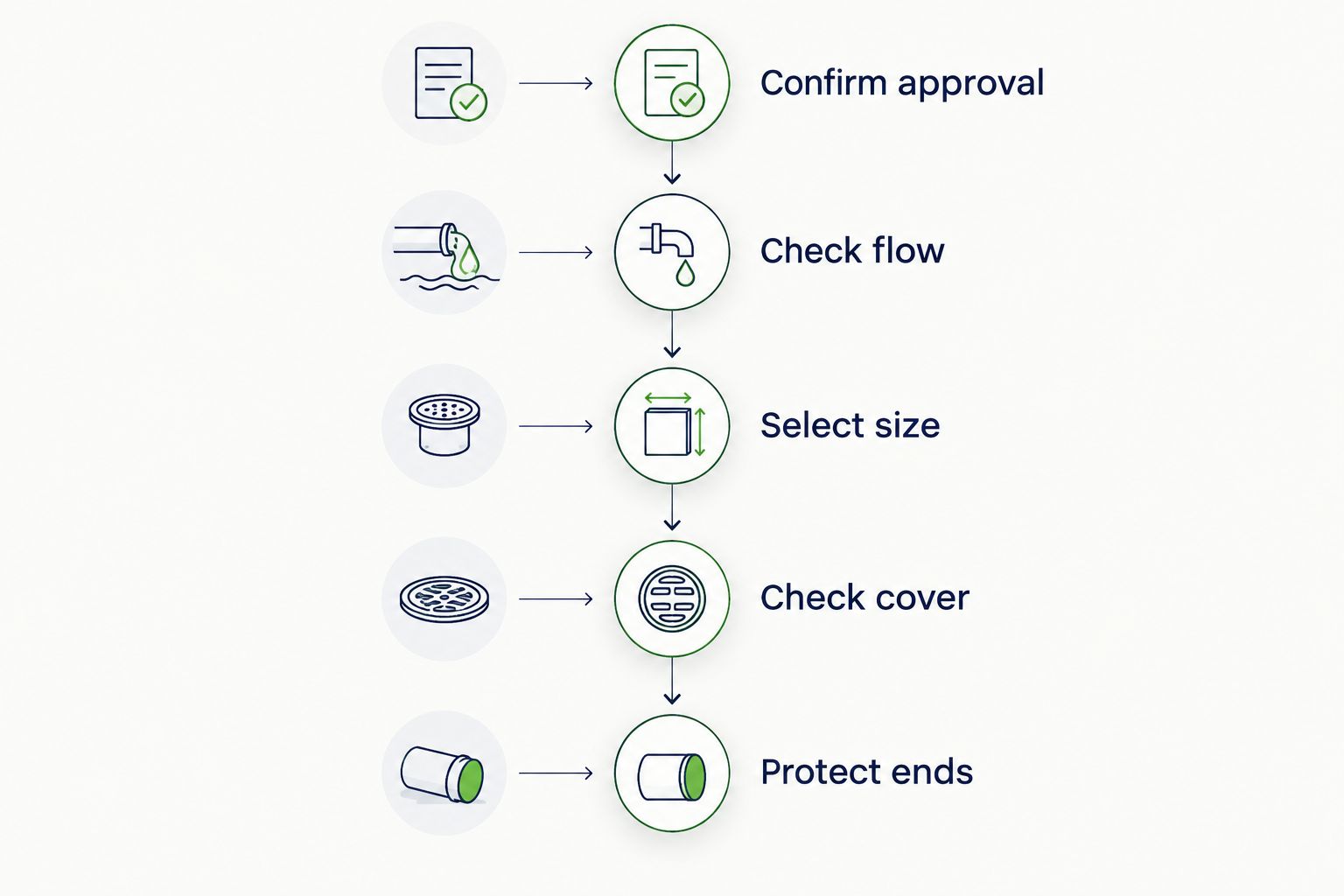
Confirm approval
Identify the authority responsible for the connection. A city street, county road and state-road connection do not automatically follow the same approval process. For state-road work in 2026, consult the current Florida Department of Transportation drainage criteria and applicable specifications; do not assume those requirements replace local requirements elsewhere.
Check flow
Record the ditch direction, upstream drainage and downstream outlet conditions. Pipe slope must fit the larger drainage path. A culvert cannot discharge properly into an outlet that remains backed up.
Select size
A drawing showing a 12-inch, 18-inch or 24-inch nominal pipe identifies different openings—not three interchangeable choices. Those dimensions are examples, not recommendations for your property. Hydraulic design must account for the inlet, slope, tailwater and allowable upstream water level.
Check cover
Cover is the depth above the pipe, not the trench depth. Confirm the required cover for the exact pipe, loading and installation. If the driveway profile leaves too little room, stop and revise the design rather than guessing at a stronger material.
Protect ends
Specify inlet and outlet treatment, erosion protection and any required safety details. Keep the pipe ends accessible and avoid changing the swale in a way that blocks neighboring drainage.
What belongs in a culvert installation scope?
Ask for enough detail to compare the work, not just the material name. Two proposals that both say install drainage pipe can describe very different installations.
- Pipe identification: Material, product designation, diameter, length and required joints.
- Excavation and bedding: How unsuitable material will be handled and how the foundation will be prepared.
- Backfill: Specified material, placement and compaction around the pipe.
- Elevations: Inlet and outlet levels tied to the intended drainage direction.
- End treatment: Headwalls, end sections or erosion protection where the design requires them.
- Driveway coordination: Finished surface elevation, edge support and construction sequence.
- Acceptance: Required inspections and responsibility for correcting nonconforming work.
Green Hammer Concrete provides concrete driveway construction and repair in Palm Bay and Brevard County. Keep the concrete scope and drainage scope coordinated so the finished entrance follows the accepted crossing design.
How the materials are ranked
This ranking prioritizes local acceptance, drainage performance, structural requirements, corrosion exposure and installation demands. It favors dual-wall HDPE as the first residential option to evaluate, not as a universal replacement for concrete or metal.
The heavy-load, lightweight-metal and protected-steel categories identify different project needs. An approved design outranks the order of this list. No fixed service-life claim applies across every Florida soil, water condition and installation.
Which culvert pipe should you choose?
Start with dual-wall HDPE for an approved residential driveway crossing; choose another material when the design or exposure calls for it. Reinforced concrete fits specified rigid-pipe applications. Aluminum and coated steel require a deliberate review of corrosion conditions and protection.
For 2026 planning, make the next move an approval and elevation check—not a pipe purchase. Confirm the responsible authority, then get a scope that connects the drainage design to the finished driveway.
FAQ
What's the best culvert pipe material for a Florida driveway?
Approved dual-wall HDPE is a practical first option for a residential driveway crossing. The final choice depends on local acceptance, hydraulic sizing, vehicle loading, required cover and installation conditions.
Is concrete culvert pipe better than plastic?
Concrete is not automatically better than plastic. Reinforced concrete is a rigid pipe with specified structural classes, while HDPE relies on properly installed surrounding soil as part of its structural system.
Can I replace my culvert with the same size pipe?
Do not assume the existing size is acceptable for a replacement. Confirm current requirements and check whether inadequate capacity, settlement or outlet conditions contributed to the problem.
How deep should a driveway culvert be buried?
Required burial cover depends on the exact pipe, vehicle loading and installation specification. Confirm the distance from the top of the pipe to the finished surface before setting the driveway elevation.
Is aluminum culvert pipe safe to use near the Florida coast?
Aluminum requires a site-specific exposure check rather than approval based on coastal location alone. Soil chemistry, water chemistry, abrasion and dissimilar-metal contact affect its suitability.
Do I need approval to replace a driveway culvert in Palm Bay?
Confirm approval requirements with the authority responsible for the road and drainage connection before replacing a culvert. A replacement still affects the swale and downstream drainage, even when the driveway footprint stays unchanged.
Who should coordinate the culvert and concrete driveway work?
The project scope should assign responsibility for drainage approval, pipe installation and finished driveway elevations. Green Hammer Concrete provides concrete driveway construction and repair for Palm Bay and Brevard County property owners; confirm the drainage responsibilities before work starts.
One last thing
Photograph both pipe openings and the swale after rain before discussing a replacement. Standing water, sediment lines and erosion give the designer useful context. A clear pipe is not proof of a working crossing if the outlet elevation or downstream ditch prevents drainage.