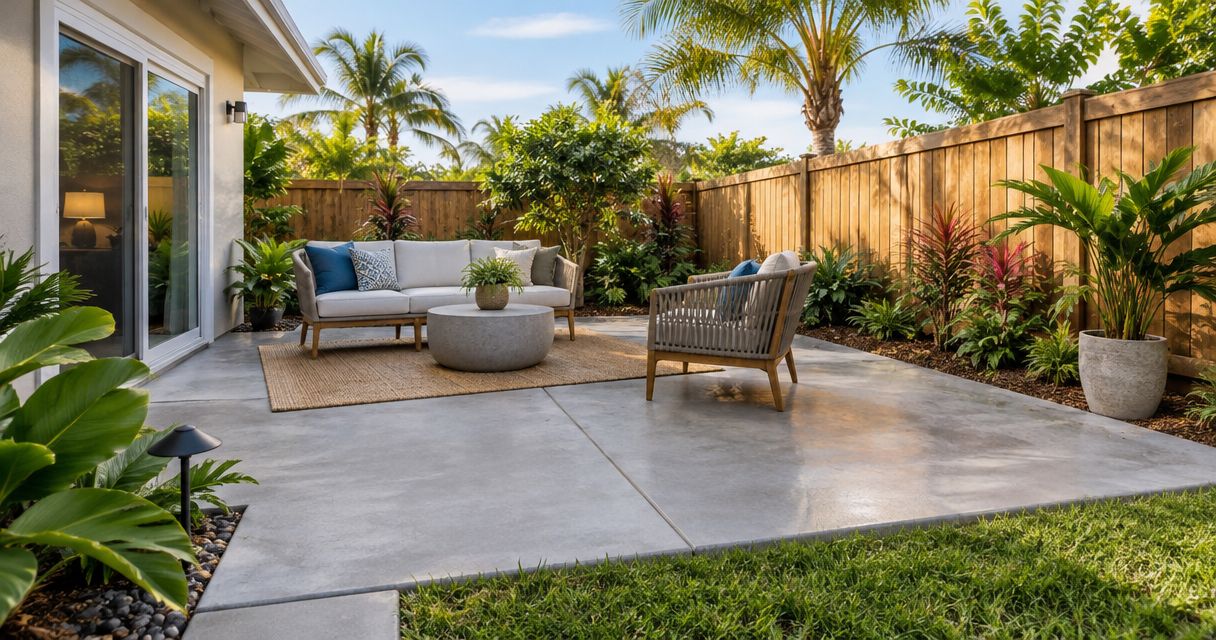
Best overall: broom-finished concrete; best for decorative texture: exposed aggregate; best no-frills option: plain concrete with a broom finish. For a small Palm Bay backyard in 2026, choose the surface around drainage, wet-weather footing and furniture use—not the pattern alone.
- Best concrete patio materials small backyard: broom-finished concrete is the practical default for everyday outdoor use.
- Exposed aggregate suits decorative texture; stamped concrete suits homeowners who want a patterned slab.
- Concrete pavers allow individual-unit replacement, but joints need attention; overlays require a sound existing slab.
- Green Hammer Concrete provides concrete patio construction and repair for Palm Bay and Brevard County property owners.
Why this matters in a small Palm Bay backyard
A small patio has little spare room for an awkward step, a rocking chair or a low spot that holds water. Choose the surface and the drainage layout together. Decorative work does not correct a poorly supported slab or water directed toward the house.
Green Hammer Concrete is a family-owned contractor serving residential and commercial property owners in Palm Bay and Brevard County. For your 2026 patio project, separate the construction decisions from the appearance decisions: base preparation, elevations and joints come before color and pattern.
The options below include finishes, paving units and resurfacing materials. Broom finishing, exposed aggregate and stamping describe treatments to concrete; concrete pavers are separate units; a cementitious overlay goes over an existing surface. They solve different problems.
What makes the best concrete patio material?
Use these criteria before choosing a finish:
- Wet-weather footing: Judge the finished surface, including its sealer, rather than assuming any textured concrete is slip-proof.
- Furniture stability: Chair legs and table feet need usable contact with the surface. Deep relief and coarse aggregate deserve a physical sample check.
- Drainage compatibility: Surface texture cannot compensate for the wrong elevations, blocked outlets or a poorly planned transition at the door.
- Repair practicality: Consider how a crack, stain or damaged area will look after repair—not just on installation day.
- Maintenance: Decide whether you want to manage paving joints, renew a coating or preserve a decorative finish.
- Visual scale: A small backyard benefits from a pattern that fits the available space without awkward cuts along every edge.
Small-backyard patio options at a glance
For 2026 planning, this ranking favors straightforward everyday use first, then specific decorative or repair needs. No surface wins every category.
| Option | Best for | Standout feature | Key limitation |
|---|---|---|---|
| Broom-finished concrete | Everyday dining and seating | Simple, textured slab surface | Cracks and repairs can remain visible |
| Exposed aggregate | Decorative texture | Visible stone in the wearing surface | Coarse exposure can feel rough underfoot |
| Stamped concrete | Pattern-led backyard design | Pattern impressed into a continuous slab | Decorative repairs are difficult to blend |
| Concrete pavers | Individual-unit replacement | Separate paving units | Joints and edge restraint need attention |
| Cementitious overlay | Updating sound existing concrete | Resurfaces a suitable slab | Does not repair underlying movement |
1. Broom-finished concrete: best for everyday patio use
Broom-finished concrete gets its texture from a broom drawn across the surface during finishing. It gives you a straightforward patio without decorative grooves or exposed stones competing with furniture placement.
For a small backyard used mainly for meals, chairs and a grill, broom-finished concrete is the default choice. Ask to see the intended texture: a heavy broom finish feels different from a lighter one, especially under bare feet.
Broom-finished concrete pros:
- Simple texture suits a patio with several everyday uses.
- The plain surface does not depend on aligning a decorative pattern.
- Cleaning does not require working around deep stamped relief.
Broom-finished concrete cons:
- Cracks, patches and discoloration can remain noticeable.
- An overly aggressive texture feels rough and collects dirt.
Best for: Homeowners prioritizing a usable seating surface over decorative detail.
Keep the edges, joints and drainage intentional. A plain slab still needs careful construction; a broom finish is not a substitute for any of those decisions.
Verdict: Buy for a practical, everyday backyard patio.
2. Exposed aggregate: best for decorative texture
Exposed aggregate reveals stone at the concrete surface rather than leaving a paste-finished appearance. Its character comes from the aggregate selection and how deeply that aggregate is exposed.
Choose it when you want visible texture without an imitation stone or brick pattern. Before committing, compare a cured sample with the kind of shoes—or bare feet—you expect on the patio.
Exposed aggregate pros:
- Visible aggregate gives the surface a distinct appearance.
- The design does not depend on repeated stamped shapes.
- Aggregate selection provides a different look from plain concrete.
Exposed aggregate cons:
- Coarse or deep exposure can be uncomfortable underfoot.
- Dirt collects around exposed stones, and repairs can be difficult to match.
Best for: Homeowners who value stone texture more than a relatively even walking surface.
Use the actual finish sample to check furniture stability. Attractive aggregate alone does not tell you whether narrow chair legs will sit well on the finished patio.
Verdict: Buy when the sample passes your barefoot and furniture checks.
3. Stamped concrete: best for a pattern-led backyard
Stamped concrete uses impressions to create a decorative pattern in a concrete slab. Color and finishing treatments add to the appearance, but the patio remains concrete underneath.
In a compact yard, plan the pattern against the actual boundaries. A pattern that looks good across a large display can leave awkward fragments beside a doorway, fence or curved edge.
Stamped concrete pros:
- Pattern and color can coordinate the patio with its surroundings.
- A continuous slab provides a patterned alternative to separate paving units.
- Planned borders can distinguish seating areas from circulation space.
Stamped concrete cons:
- Relief can interfere with chair feet and collect debris.
- Matching pattern, color and sheen during repair is difficult.
- Some sealer-and-texture combinations become slippery when wet.
Best for: Homeowners making decorative appearance the main selection criterion.
Ask how control joints will cross the pattern and what maintenance the specified sealer requires. Do not approve the design from a dry photograph alone; wet-surface performance matters on an outdoor patio.
Verdict: Buy for a deliberate design; skip if easy repair is your priority.
4. Concrete pavers: best for individual-unit replacement
Concrete pavers create a patio from separate manufactured units installed over a prepared supporting system. They are not the same construction as a poured concrete slab, even though both use concrete.
Their main advantage here is repair access. Individual units can be lifted and replaced, although replacement pieces can differ in appearance from weathered ones.
Concrete paver pros:
- Individual damaged units can be replaced.
- Units can be lifted to address localized base problems.
- Layout and unit selection provide several design approaches.
Concrete paver cons:
- Joints require maintenance and can support weeds when debris accumulates.
- Poor base preparation or edge restraint allows movement.
- Small cuts around boundaries can clutter a compact layout.
Best for: Homeowners who prioritize localized repair and accept joint maintenance.
Do not assume ordinary pavers create a permeable patio. Permeable paving requires an appropriate unit, joint and base system; the presence of joints alone does not establish drainage performance.
Verdict: Buy for replaceable units; skip if joint upkeep is unwelcome.
5. Cementitious overlay: best for a sound existing patio
A cementitious overlay places a new wearing surface over suitable existing concrete. It is a resurfacing choice, not a replacement for a failed slab or an answer to active settlement.
Start with the existing patio's condition. Loose material, contamination, moisture conditions and moving cracks affect whether an overlay system is appropriate.
Cementitious overlay pros:
- Can update the appearance of suitable existing concrete.
- Retains the underlying slab when that slab is serviceable.
- Provides finish options without replacing the entire patio.
Cementitious overlay cons:
- Existing movement can cause cracks to show through.
- Bonding depends on preparation and system compatibility.
- Added surface height requires checks at doors and adjoining surfaces.
Best for: Homeowners with a stable patio that needs a surface update rather than reconstruction.
Verdict: Hold until the existing slab has been assessed; skip over an unresolved structural or drainage problem.
Plan the patio before choosing its appearance
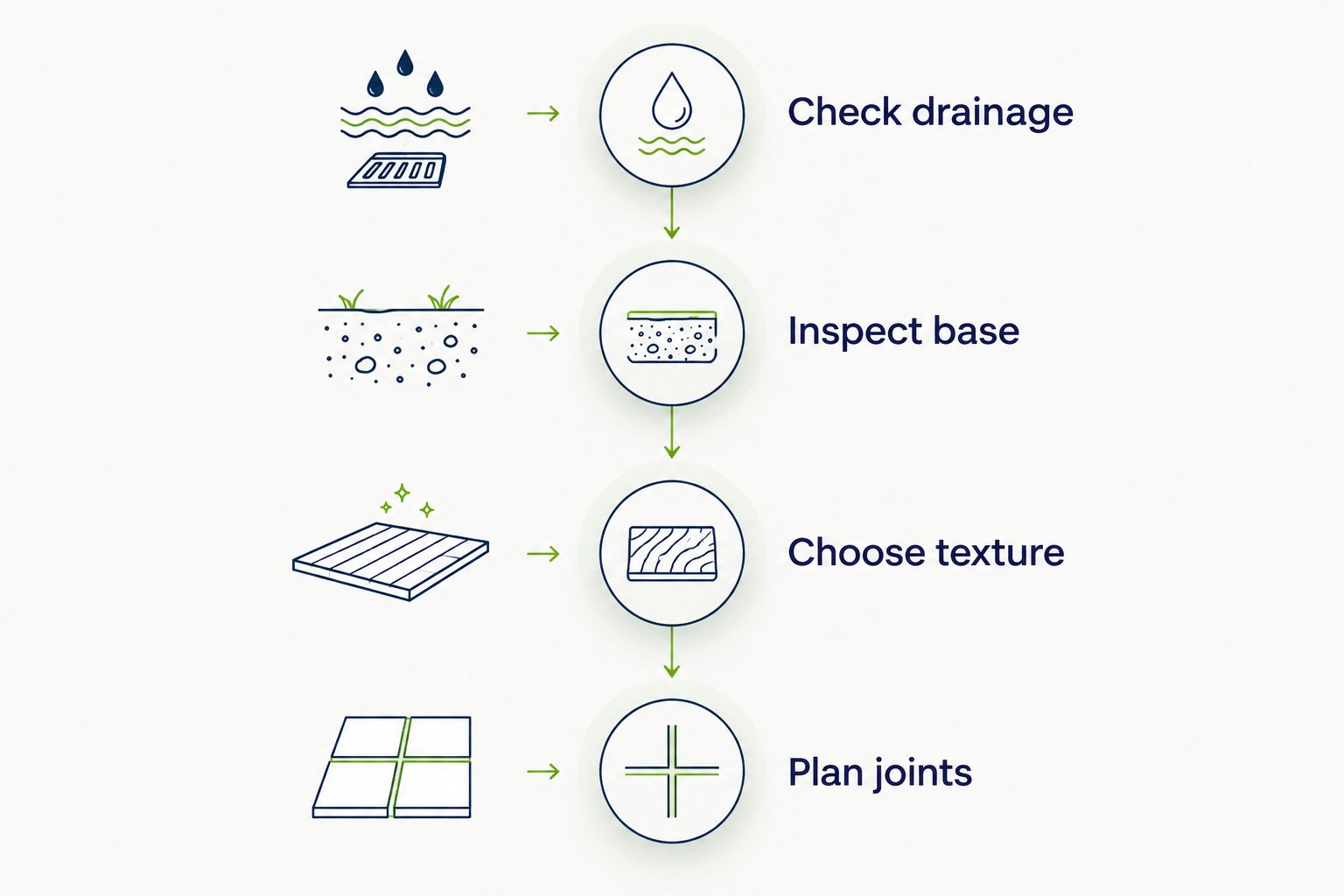
A small patio still needs a construction plan. Work through these decisions in order so the surface choice supports the site rather than hiding a problem.
Check drainage
Identify where rainwater will leave the patio and where it will go next. Protect the house, preserve necessary drainage routes and check adjoining grades rather than looking only at the proposed slab.
For a simple planning example, a slope of 1/4 inch per foot across an 8-foot run creates a 2-inch fall. That calculation illustrates elevation change, not a site specification; door thresholds, accessibility requirements and the receiving area determine the appropriate design.
Inspect base
The supporting ground matters beneath both poured concrete and pavers. Address soft areas, buried debris and disturbed fill before installing the surface. Choosing a thicker-looking finish does not correct inadequate support.
Choose texture
Compare physical samples where possible. Check how the surface feels, how furniture sits and what the specified sealer changes. For a frequently barefoot patio, comfort deserves equal attention to appearance.
Plan joints
Discuss joint locations before the pour. Concrete shrinks as it dries, and planned joints help manage where cracking occurs; they do not guarantee a crack-free slab. Coordinate joints with the patio shape, pattern and transitions.
These decisions belong in your 2026 project discussion before a decorative finish is selected. The order matters: establish water movement and support, then choose the surface details.
How the options rank
The ranking puts ordinary patio use ahead of decorative complexity. Broom-finished concrete leads because it provides a straightforward textured slab; exposed aggregate and stamped concrete serve distinct appearance preferences. Pavers address individual-unit replacement, while overlays address suitable existing concrete.
These are use-case recommendations, not claims that every installation performs alike. Base preparation, drainage, workmanship and maintenance remain separate from the material label.
Which patio material should you choose?
Choose broom-finished concrete if you want a practical patio and have no strong decorative preference. Choose exposed aggregate for visible stone texture, stamped concrete for a planned pattern, or pavers when individual-unit replacement matters most. Consider an overlay only after confirming the existing slab is suitable.
Green Hammer Concrete is a fit for Palm Bay property owners seeking concrete patio construction or repair. Bring the intended furniture layout, photographs of water after rain and a clear description of how you use the yard to the project discussion.
For a 2026 installation, ask for a scope that identifies preparation, drainage, joints and the proposed finish. A finish name alone is not a complete patio specification.
FAQ
What's the best concrete patio material for a small Palm Bay backyard?
Broom-finished concrete is the practical default for an everyday small patio. Exposed aggregate, stamped concrete and pavers suit different priorities, including decorative texture, pattern and individual-unit replacement.
Is stamped concrete better than plain concrete for a small patio?
Stamped concrete is better for a specific decorative pattern, not automatically for everyday use. Broom-finished concrete keeps the surface simpler, while stamped relief and sealers require attention to furniture stability and wet-weather footing.
Are concrete pavers easier to repair than a poured patio?
Concrete pavers allow individual units to be lifted and replaced. That makes localized work practical, but base problems still need correction and replacement units can look different from weathered paving.
Can an overlay fix a cracked concrete patio?
An overlay does not correct active movement or inadequate support beneath a patio. Assess the cracks and drainage first, then determine whether repair, resurfacing or replacement addresses the underlying problem.
Which concrete patio finish is best for bare feet?
A controlled, lighter broom texture is a practical starting point for barefoot use. Check a cured sample because coarse exposed aggregate and aggressive textures can feel rough, and any outdoor surface can become hot in direct sun.
How should I compare patio proposals in 2026?
Compare the construction scope before comparing decorative finishes. Check what each proposal includes for removal, base preparation, drainage, concrete or paving construction, joints and surface treatment.
Does Green Hammer Concrete handle patio construction and repair?
Green Hammer Concrete provides concrete patio construction and repair for residential and commercial property owners in Palm Bay and Brevard County. Discuss the existing conditions and intended use to determine the appropriate project scope.
One last thing
Place your furniture layout on the plan before approving the joints and pattern. A decorative border loses its purpose if the dining table hides it, and an awkward transition matters more when it lands beneath a chair. Design the usable space first; finish the concrete second.