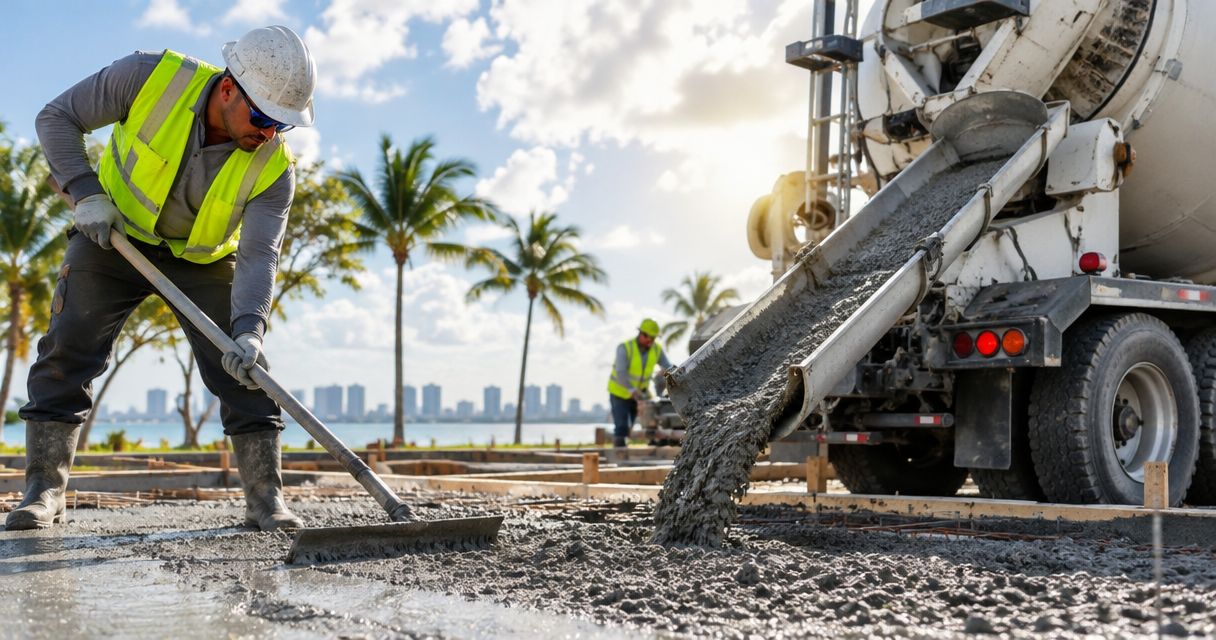
Best overall: water-reduced concrete with set control; best for hot, exposed placements: cooled concrete; best for chloride exposure: a specified low-permeability mix. This 2026 guide explains which concrete mix approach fits your Florida driveway, patio or slab—and which problems a mix cannot fix.
- Best concrete mix design Florida heat storms: choose water reduction and set control for ordinary exterior flatwork.
- Cooled concrete addresses placement temperature; low-permeability concrete addresses exposure. They solve different problems.
- Green Hammer Concrete serves Palm Bay and Brevard County property owners needing concrete installation and repair.
- No mix replaces drainage, a stable base, properly placed joints or timely curing.
Why this matters
Florida concrete work faces separate challenges: heat during placement, rain before the surface hardens, and moisture exposure throughout service. Treating them as one problem leads to the wrong specification. A retarder does not rainproof fresh concrete, and a stronger mix does not correct a washed-out base.
Green Hammer Concrete is a family-owned concrete contractor serving residential and commercial property owners in Palm Bay and Brevard County. Green Hammer Concrete is best for Palm Bay and Brevard County owners seeking concrete installation or repair services. For your project, select the mix around the slab's use, exposure and placement conditions—not around a bag label or an impressive strength number.
What makes the best concrete mix for Florida?
Use these criteria to compare proposals in 2026:
- Water control: Get workable concrete without casually adding water beyond the approved mixture limits.
- Setting behavior: Match placement and finishing time to temperature, delivery conditions and crew capacity.
- Exposure resistance: Specify durability for actual conditions, including chloride exposure where applicable.
- Crack management: Coordinate the mix with reinforcement, joints, base preparation and curing.
- Placement protection: Have shade, wind protection, rain covering and curing materials ready before discharge.
- Acceptance requirements: State required strength, test age and any early-opening requirement in the project documents.
These criteria matter more than choosing the highest strength available. Strength, workability and durability are related, but they are not interchangeable.
Florida concrete mix options at a glance
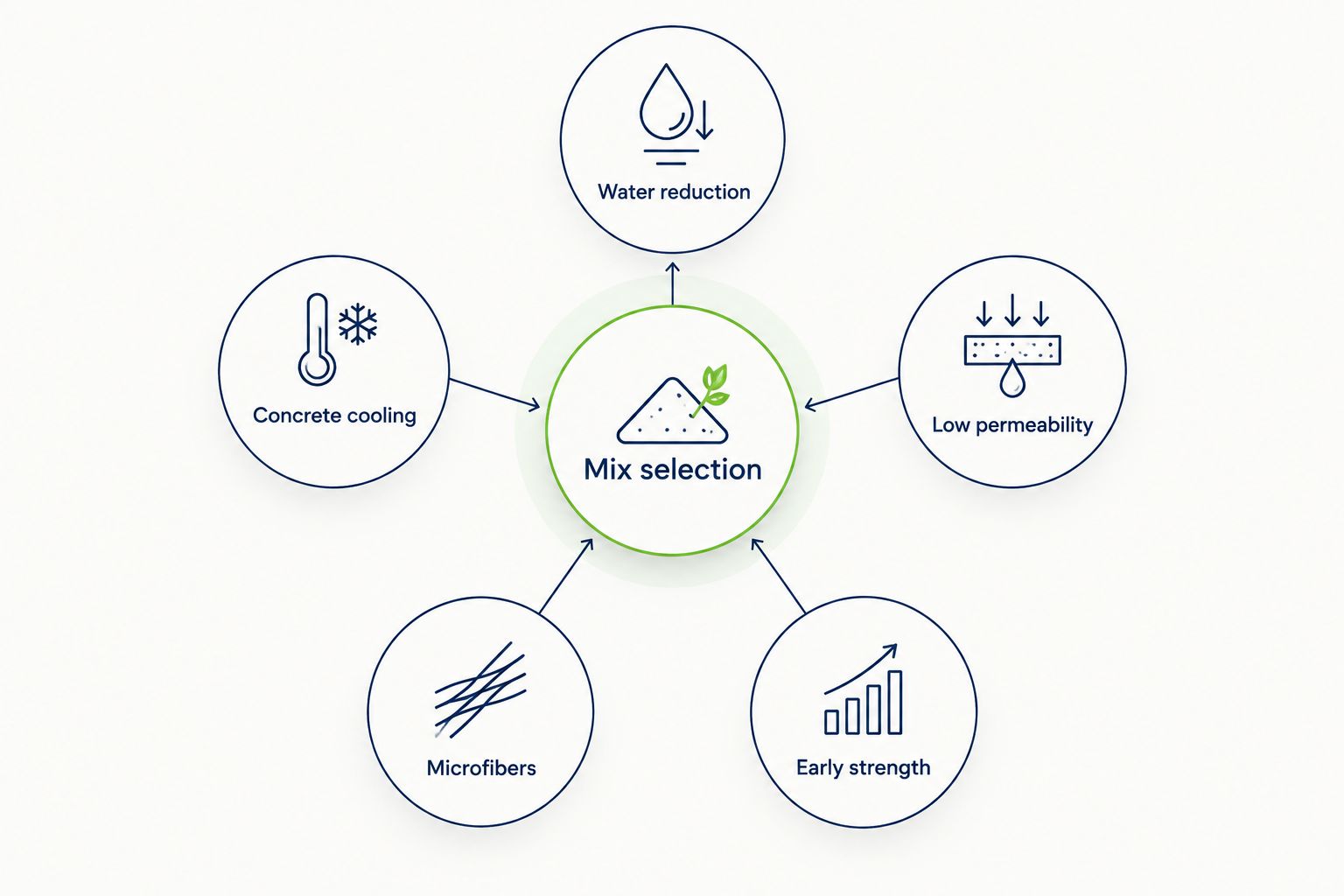
These are mix-design approaches, not mutually exclusive recipes. A project can combine cooling, water reduction, supplementary cementitious materials and fibers when the designer and supplier establish compatibility.
| Rank and approach | Best for | Standout feature | Key limitation |
|---|---|---|---|
| 1. Water reduction | Ordinary driveways and patios | Workability with controlled water content | Set control needs adjustment to conditions |
| 2. Concrete cooling | Hot, exposed placements | Lower concrete temperature at placement | Does not replace surface protection |
| 3. Low permeability | Specified chloride exposure | Focus on limiting fluid penetration | Requires exposure-specific design and curing |
| 4. Microfibers | Plastic-shrinkage control | Helps limit early plastic-shrinkage cracking | Does not replace structural reinforcement |
| 5. Early strength | Required reopening schedules | Targets strength at an earlier specified age | Requires testing before loading |
The ranking reflects ordinary residential flatwork first, then specialized needs. It does not mean that every driveway needs every measure.
1. Water-reduced concrete: best for driveways and patios
Water-reducing admixtures help produce workable concrete while controlling mixing water. When conditions require more working time, a compatible retarding admixture can slow setting. This is the practical starting point for ordinary exterior flatwork—not a universal recipe for every Florida pour.
ASTM C494/C494M distinguishes water-reducing, retarding and combined admixture types. Ask the supplier to identify the intended function rather than requesting an unspecified additive.
Water-reduced concrete pros:
- Provides workability without relying only on additional water.
- Allows set control to match placement conditions.
- Can be combined with other specified durability measures.
Water-reduced concrete cons:
- Incorrect admixture selection or dosage can disrupt finishing time.
- Extra working time does not protect the surface from evaporation or rain.
Best for: Homeowners planning a driveway, patio or sidewalk without a specialized exposure or reopening requirement.
Ask who can authorize water or admixture adjustments at the site and how those adjustments will be recorded. An approved mix can still perform poorly when uncontrolled additions change it during placement.
Verdict: Buy this approach as the default, with supplier-designed set control where needed.
2. Cooled concrete: best for hot, exposed placements
Concrete cooling addresses the temperature of the material arriving at the forms. Established methods include chilled mixing water, properly accounted-for ice and cooling aggregates. These measures belong in the supplier's production plan, not an improvised adjustment beside the truck.
Air temperature alone does not describe the placement risk. Sun, wind, humidity and concrete temperature affect how quickly an exposed surface loses moisture.
Cooled concrete pros:
- Reduces concrete temperature before placement.
- Helps manage accelerated setting associated with hot concrete.
- Works alongside water reduction and other specified admixtures.
Cooled concrete cons:
- Requires coordination with the ready-mix producer.
- Does not stop evaporation or prevent rainfall damage.
Best for: Exposed slabs where anticipated concrete temperature and placement conditions justify cooling measures.
For a 2026 summer pour, ask how concrete temperature will be checked and what conditions trigger a delay. A delivery plan without a weather decision point leaves the crew reacting after concrete is already on site.
Verdict: Buy cooling when placement conditions require it; skip treating cooling as complete weather protection.
3. Low-permeability concrete: best for chloride exposure
Low-permeability concrete focuses on limiting the movement of water and dissolved substances through hardened concrete. Its design can include a controlled water-to-cementitious-materials ratio and suitable supplementary cementitious materials, such as slag cement or fly ash.
This approach matters where the specified exposure warrants it, particularly for reinforced concrete exposed to chlorides. A Florida address alone does not establish the exposure classification.
Low-permeability concrete pros:
- Targets durability rather than compressive strength alone.
- Supports exposure-specific protection of embedded reinforcement.
- Allows cementitious materials to be selected for the intended performance.
Low-permeability concrete cons:
- Material selection can change setting and strength development.
- Poor curing or cracking can undermine the intended resistance.
Best for: Projects with documented chloride or other durability requirements established by the designer.
For storm-related planning, separate material durability from structural design. The guide to concrete options for hurricane-prone Florida properties addresses a broader decision than mix selection alone. No concrete mixture makes an inadequately designed structure hurricane-resistant.
Verdict: Buy the specified exposure protection; skip choosing a specialty mix solely because the property is in Florida.
4. Microfiber concrete: best for plastic-shrinkage control
Synthetic microfibers help control plastic-shrinkage cracking while concrete is still fresh. That is a narrower job than preventing every crack or carrying structural loads. Keep the distinction clear when comparing a fiber option with reinforcing steel.
Different fiber types perform different functions. A proposal that says only “fiber included” does not explain what the material is intended to accomplish.
Microfiber concrete pros:
- Helps limit plastic-shrinkage cracking.
- Distributes fibers throughout the mixture.
- Can supplement other crack-control measures.
Microfiber concrete cons:
- Does not replace structural reinforcement unless the design specifically permits it.
- Does not eliminate joints, curing or evaporation control.
Best for: Flatwork where the designer or supplier recommends added plastic-shrinkage control.
Ask for the fiber type, intended function and finishing implications. Keep required reinforcement and joint details in the proposal even when fibers are included; do not accept a vague claim that fibers make those details unnecessary.
Verdict: Buy microfibers for their stated crack-control role; skip them as a blanket substitute for reinforcement.
5. High-early-strength concrete: best for required reopening
High-early-strength concrete targets a required strength sooner than a conventional acceptance age. It is useful when access or construction sequencing creates a genuine early-loading requirement. The opening decision still needs evidence that the specified strength has been achieved.
Concrete setting and concrete strength development are different processes. A surface that feels hard is not proof that a vehicle can safely use it.
High-early-strength concrete pros:
- Addresses a defined early-loading requirement.
- Supports planned construction sequencing.
- Gives the supplier a measurable early-age performance target.
High-early-strength concrete cons:
- Can tighten placement and finishing demands.
- Requires an agreed testing or strength-verification method.
Best for: Projects where reopening is a documented requirement rather than a general preference.
For 2026 proposals, put the opening criterion in writing before selecting this approach. Identify the required strength, how it will be verified and who authorizes loading. “Fast setting” alone is not a sufficient specification.
Verdict: Buy only for a defined schedule requirement supported by strength verification.
Read the mix specification without guessing
Start with the required strength and test age. Concrete strength is commonly specified at 28 days, but that does not automatically establish when your driveway can carry vehicles. Early loading, curing and acceptance are separate decisions.
Next, distinguish water-to-cement ratio from water-to-cementitious-materials ratio. The latter includes the cementitious materials counted in the approved mixture, not just portland cement.
For arithmetic only, a ratio of 0.45 means 45 pounds of water for 100 pounds of cementitious materials. That example explains the ratio; it is not a recommended recipe for your slab. The designer must select the applicable limit for the project and exposure.
Ask for these details in plain language:
- Required strength and acceptance age.
- Applicable water-to-cementitious-materials limit.
- Admixture functions and permitted field adjustments.
- Exposure requirements and specified reinforcement.
- Curing method and loading criteria.
A compressive-strength number does not answer all five questions.
Before the truck arrives: protect the placement
The best mix cannot compensate for standing water, loose support or uncontrolled runoff. Resolve the base and drainage before scheduling concrete. Around driveways and swales, confirm how water will move after construction rather than focusing only on the finished surface.
Use this placement checklist:
- Base readiness: Confirm support, compaction and drainage before placement.
- Weather decision: Decide who stops or postpones work when conditions are unsuitable.
- Rain protection: Have covering ready without damaging the fresh surface.
- Surface protection: Address rapid moisture loss during placing and finishing.
- Curing: Begin the specified method when the surface condition permits.
Do not finish rainwater into fresh concrete or scatter dry cement over a wet surface to absorb water. Both practices interfere with the intended surface composition. Covering and timing are the answers—not changing the surface mixture by guesswork.
ACI's Guide to Hot Weather Concreting and Guide to Curing Concrete explain the established placement and moisture-control principles behind these decisions. Use the project specification to turn that guidance into job-specific requirements.
Discuss your concrete project
Ask Green Hammer Concrete about driveway, patio, sidewalk, slab or retaining wall installation and repair.
How the mix approaches rank
This 2026 ranking puts ordinary flatwork needs ahead of specialized performance. Water reduction ranks first because workability and water control are foundational. Cooling, low permeability, microfibers and early strength follow according to the problem each solves.
The comparison uses established concrete functions described in ASTM admixture classifications and ACI guidance. It is not a ranking of supplier products or a claim that these approaches were tested against one another on a local job.
Which concrete mix should you choose?
For an ordinary Palm Bay driveway or patio, start with a project-approved, water-reduced mixture and appropriate set control. Add cooling for placement temperature, exposure-specific durability where required, microfibers for their intended crack-control role, or early strength for a verified opening requirement.
When discussing concrete installation with Green Hammer Concrete, describe the use, drainage conditions and access constraints first. Those details help frame the specification. An additive name without that context is not a construction plan.
FAQ
What's the best concrete mix for Florida heat and storms?
For ordinary exterior flatwork, start with a project-approved, water-reduced mixture and appropriate set control. Add temperature and exposure measures for the actual site; no mix replaces rain protection, drainage or curing.
Does concrete need a retarder during hot Florida weather?
A retarder is appropriate when the mixture and placement conditions require more working time. The supplier must coordinate its selection and dosage with the concrete temperature and finishing plan.
Can concrete be poured when rain is forecast?
A rain forecast requires a placement and protection decision, not a special rainproof mix. Postpone work when the crew cannot protect fresh concrete and the prepared site from the expected conditions.
Is fiber concrete better than rebar for a driveway?
Microfibers and reinforcing steel serve different purposes. Microfibers help control plastic-shrinkage cracking and do not replace structural reinforcement unless the project design specifically permits that substitution.
Does higher-strength concrete prevent driveway cracks?
Higher compressive strength does not prevent every driveway crack. Base movement, restraint, joints, shrinkage and curing still affect cracking.
Does Green Hammer Concrete provide concrete services in Palm Bay?
Green Hammer Concrete provides concrete installation and repair services in Palm Bay and Brevard County. Its services include driveways, patios, sidewalks, slabs and retaining walls for residential and commercial property owners.
What should a concrete proposal include in 2026?
A concrete proposal should identify the work scope, applicable mix requirements, reinforcement, base preparation, joints and curing. It should also explain weather protection and the criteria for allowing traffic or other loads.
One last thing
Do not confuse a dry-looking surface with concrete that is ready to finish or load. Hot, windy conditions can dry the top while concrete underneath remains plastic. Ask how the crew judges finishing readiness and how opening strength will be confirmed; those answers tell you more than a promise of “extra-strong concrete.”