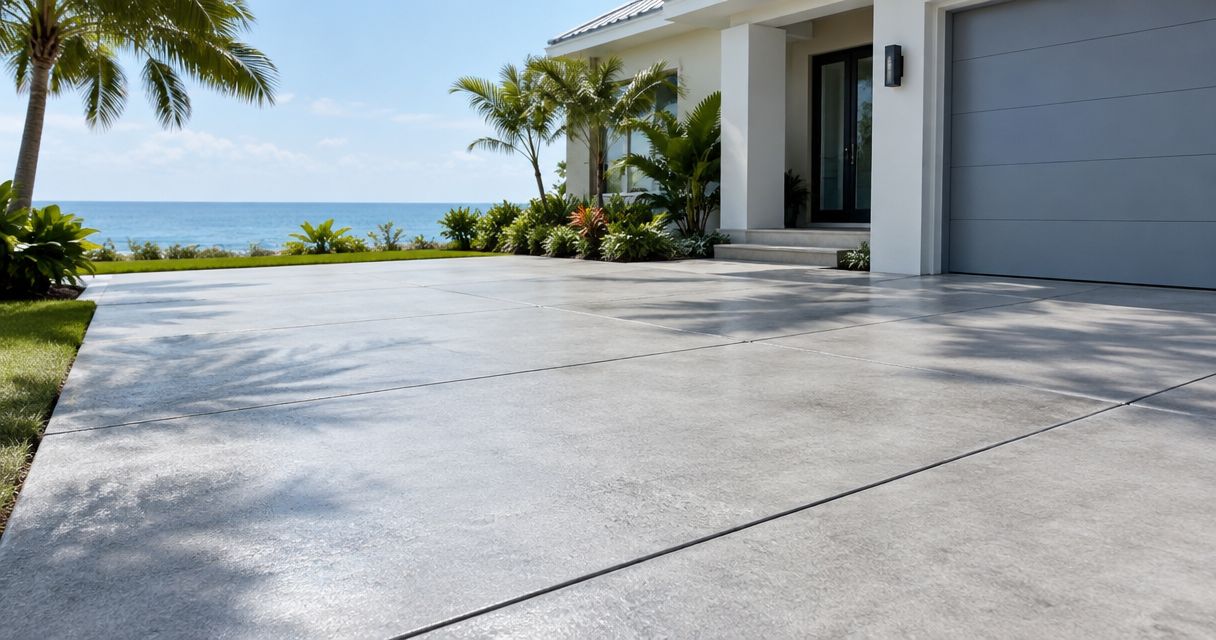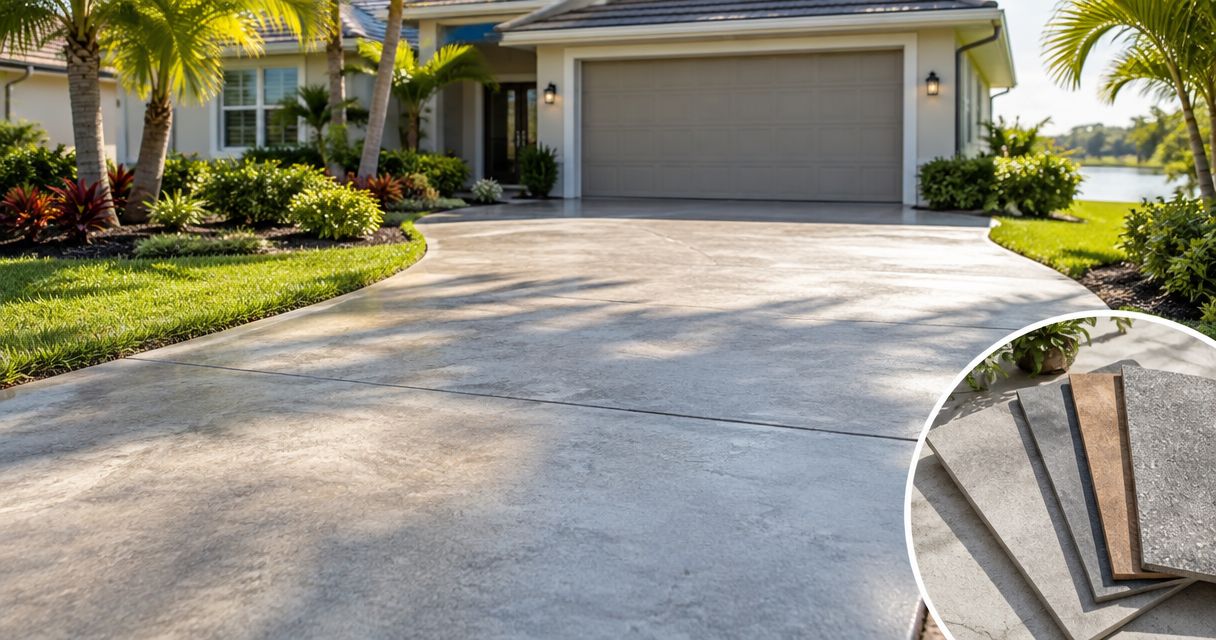
Best overall for a sound slab: a broom-finished cementitious overlay rated for vehicle traffic. Best for decorative texture: spray knockdown; best for patterns: a stamped overlay; best for fine surface correction: an exterior-rated microtopping. This 2026 guide explains which belongs on an old Florida driveway—and when none belongs there.
- The best concrete overlay options driveway owners should compare start with broom-finished cementitious systems rated for vehicles.
- Spray knockdown suits decorative texture; stamped overlays suit patterned finishes on sound concrete.
- Microtoppings suit minor surface correction, not leveling settled slabs or repairing structural cracks.
- Green Hammer Concrete provides driveway installation and repair for residential and commercial property owners in Palm Bay and Brevard County.
Why this matters
An overlay renews the surface of existing concrete. It does not replace missing support beneath a driveway, stop slab movement, or correct a drainage problem simply by covering it.
Green Hammer Concrete is a concrete installation and repair option for Palm Bay property owners assessing an old driveway. Before choosing a finish, discuss the existing slab and repair scope with Green Hammer Concrete.
Florida heat and rain affect placement, curing, and how a finished driveway performs when wet. For a 2026 project, choose the repair approach before choosing the color or pattern; otherwise, you risk paying for decoration over an unresolved defect.
What makes the best driveway overlay
Use these criteria to judge an overlay proposal before comparing appearances:
- Slab suitability: The existing concrete must provide a sound, stable surface. Loose concrete, settlement, and moving cracks need separate attention.
- Vehicle suitability: The complete system must be approved by its manufacturer for exterior driveways, not just patios or pedestrian areas.
- Wet traction: Judge the finished texture together with its sealer. A textured surface and a glossy coating are not interchangeable decisions.
- Drainage compatibility: Preserve working slopes, joints, garage transitions, and the driveway’s relationship with the roadside swale.
- Preparation requirements: The proposal should identify contaminant removal, surface preparation, repairs, and treatment of existing joints.
- Maintenance and repair: Understand cleaning, resealing requirements, and how a future patch will look beside the original finish.
No overlay wins by appearance alone. A plain finish installed over properly prepared concrete is a better choice than an elaborate pattern applied to a failing slab.
Driveway overlay options at a glance
These 2026 recommendations compare finish types, not named products. Manufacturer instructions determine whether a particular material belongs on your driveway.
| Rank and option | Best for | Standout feature | Key limitation |
|---|---|---|---|
| Broom-finished cementitious overlay | Straightforward surface renewal | Familiar concrete appearance with directional texture | Existing cracks can show through |
| Spray knockdown overlay | Decorative texture without stamped joints | Varied texture and color treatment | Sealer and texture affect wet traction |
| Stamped overlay | Patterned driveway surfaces | Patterns resembling masonry or stone | Pattern, joints, and repairs need careful coordination |
| Exterior microtopping | Fine cosmetic surface correction | Thin finish that changes surface appearance | Not a solution for settlement or deep damage |
For appearance choices beyond overlays, compare concrete driveway finishes for Florida homes. A finish describes the surface treatment; an overlay also depends on the condition of the concrete underneath.
1. Broom-finished overlay: best for straightforward renewal
A cementitious resurfacing system bonds to prepared concrete and receives a broom texture while workable. Choose a system expressly rated for exterior vehicle traffic; the word resurfacer alone does not establish driveway suitability.
This is the default recommendation when your driveway is stable but its surface looks worn. It keeps the appearance close to conventional concrete rather than adding a decorative pattern that must be matched during repairs.
Broom-finished overlay pros:
- Gives an old driveway a consistent surface appearance.
- Adds directional texture without a stamped pattern.
- Suits homeowners who want a plain concrete finish.
- Avoids decorative pattern alignment around curves and transitions.
Broom-finished overlay cons:
- Does not prevent underlying cracks from returning.
- Cannot correct settlement simply through resurfacing.
- Texture and color differences can remain visible in later repairs.
Best for: A sound driveway with surface wear and no need for a patterned finish.
Ask to see the proposed broom texture on a sample. Aggressive texture collects dirt differently from a finer finish, while an overly smooth result sacrifices the texture you selected in the first place.
Verdict: Buy this approach for straightforward renewal after slab suitability is confirmed.
2. Spray knockdown: best for decorative texture
A spray-applied cementitious overlay creates texture that is partially flattened during finishing. The result offers more visual variation than a simple broom finish without relying on a stamped stone or brick pattern.
For a driveway, the material, application, and protective finish must all suit vehicle traffic. Do not assume a system shown around a pool is suitable beneath parked cars.
Spray knockdown pros:
- Creates decorative texture without stamped joint patterns.
- Allows visual variation through texture and color selection.
- Offers an alternative to a plain resurfaced appearance.
Spray knockdown cons:
- Raised texture can retain dirt and complicate cleaning.
- Repair patches can differ in texture and color.
- Wet traction depends on the complete finished system, including sealer.
Best for: Homeowners who want a textured decorative driveway without a masonry pattern.
Request a sample showing the proposed sealer, not just unfinished material. The final protective coat can change both appearance and surface feel, so it belongs in the decision before installation.
Verdict: Buy for decorative texture only after confirming vehicle suitability and the finished surface treatment.
3. Stamped overlay: best for patterned surfaces
A stampable overlay accepts impressions while the material remains workable. It can create a patterned surface over suitable existing concrete without replacing the entire slab solely to change its appearance.
The pattern does not eliminate the driveway’s existing joints. Plan joint locations, borders, transitions, and any visible repairs before approving the layout.
Stamped overlay pros:
- Adds defined patterns to an existing driveway.
- Supports coordinated borders and decorative layouts.
- Changes appearance more substantially than plain resurfacing.
Stamped overlay cons:
- Existing joints can interrupt the decorative pattern.
- Later repairs can be difficult to match convincingly.
- Deep texture and protective coatings require attention during cleaning and maintenance.
Best for: A stable driveway where a patterned appearance is the main objective.
Look at the pattern across the whole driveway, not just a small display sample. A border that looks balanced near the garage can become awkward around a curve, walkway connection, or narrow entrance.
Keep drainage above decoration. A pattern should fit the driveway’s working elevations, not dictate changes that send water toward the garage.
Verdict: Hold until the contractor resolves joints, drainage, and pattern layout in the proposal.
4. Exterior microtopping: best for fine cosmetic correction
A microtopping is a thin cementitious finish used to change surface appearance and address minor surface irregularities. Only consider a specific system whose manufacturer approves the intended exterior vehicle use.
Thin does not mean structural. A microtopping cannot bridge a settled slab, rebuild a broken edge by itself, or substitute for repairs beneath the finish.
Exterior microtopping pros:
- Changes appearance without a deep decorative profile.
- Suits fine surface correction on an appropriate substrate.
- Provides an option when a heavily patterned finish is unwanted.
Exterior microtopping cons:
- Offers little capacity to correct elevation differences.
- Can reveal underlying cracks or defects.
- A smooth appearance requires deliberate attention to wet traction.
Best for: A sound driveway needing fine cosmetic correction rather than substantial rebuilding.
Ask exactly what the installer means by microtopping. Product suitability matters more than the category name, and the written system specification should cover the intended traffic, preparation, finish, and curing requirements.
Verdict: Skip unless the proposed system is expressly suitable for exterior driveways and the defects are cosmetic.
When an overlay is the wrong repair
A driveway that looks rough is not automatically a replacement job. Equally, a surface that can be covered is not automatically a suitable overlay candidate.
Use these conditions to guide the assessment:
- Surface wear: Worn texture or superficial deterioration calls for checking the remaining concrete before selecting resurfacing.
- Moving cracks: Cracks that change, reopen after repairs, or have uneven edges need investigation rather than concealment.
- Settlement: A low or tilted slab requires an assessment of support and elevations.
- Drainage problems: Ponding, garage entry issues, or interference with the roadside swale need a drainage plan.
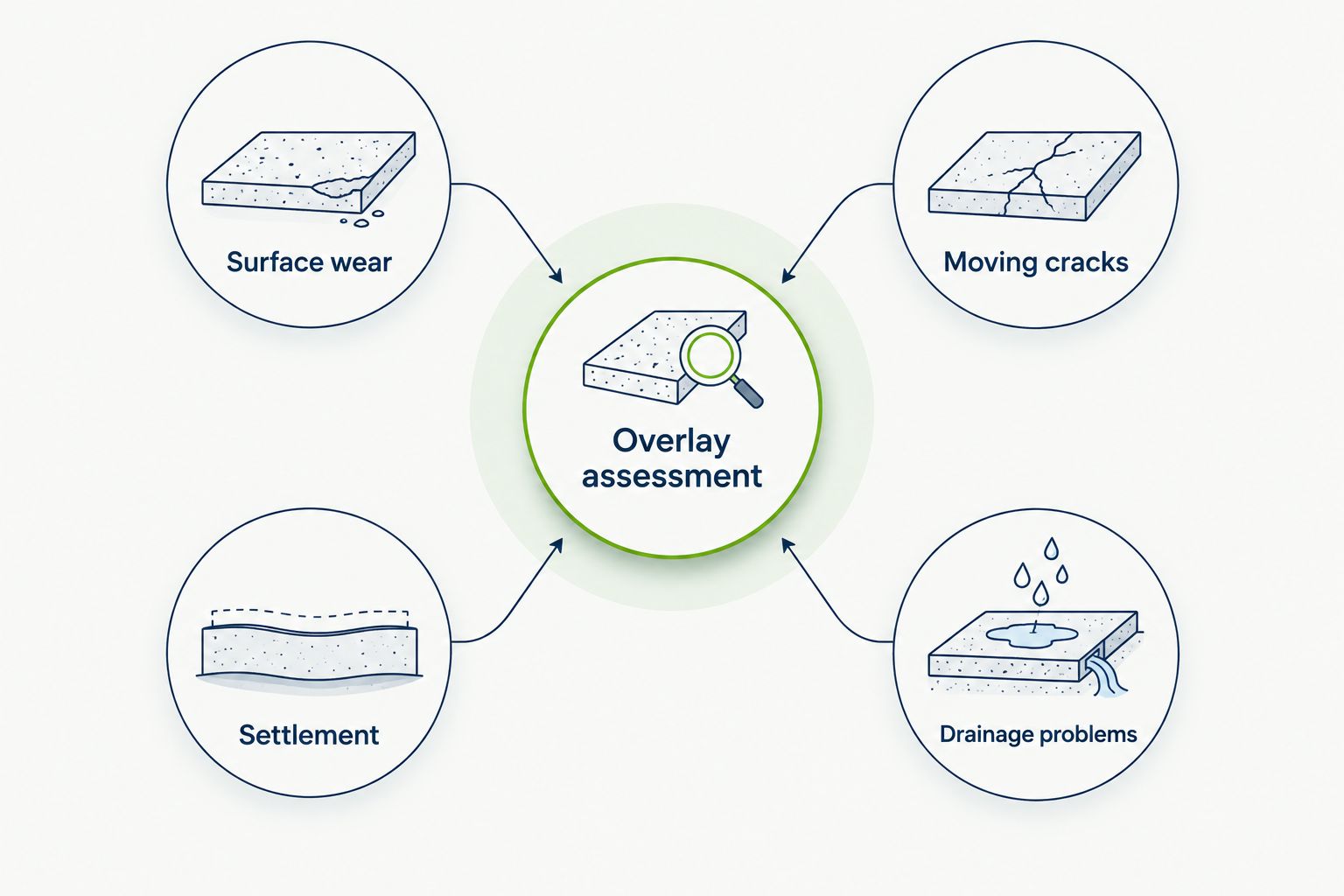
Concrete joints also need a plan. Covering an existing movement joint with a continuous decorative surface does not remove the movement beneath it.
Where the slab cannot support the proposed finish, compare repair and replacement scopes instead. Green Hammer Concrete provides both concrete installation and repair services; an overlay should not become the default simply because it changes the appearance.
What to put in the written scope
For your 2026 driveway project, request a scope that separates substrate repair from decorative work. A description such as resurface driveway leaves too much undecided.
Ask for these details:
- Preparation: How will oil, coatings, loose concrete, and other bond-breaking material be addressed?
- Repairs: Which cracks, edges, and damaged areas are included, and what treatment is proposed?
- System: What material and finish are specified for exterior vehicle traffic?
- Joints: Which existing joints remain, and how will the overlay accommodate them?
- Drainage: How will garage thresholds, sidewalks, edges, and the swale retain their intended function?
- Protection: What weather conditions, curing procedures, and manufacturer return-to-service instructions apply?
Bring 3 photographs to the discussion: the whole driveway, the worst defect, and the garage or street transition. Review a finish sample under 2 viewing conditions—dry and wet—and request 1 written scope covering preparation through curing. These are planning steps, not material specifications.
Do not set your vehicle return date from a generic online rule. The selected system, application conditions, and manufacturer instructions determine when the driveway can take traffic.
Discuss your driveway repair
Talk through driveway installation or repair needs in Palm Bay and Brevard County.
How these options were ranked
The 2026 ranking prioritizes sound-substrate compatibility, exterior vehicle suitability, wet traction, drainage, preparation, and repair practicality. It is a use-case guide, not a product test or a claim that every material in a category performs alike.
Broom-finished overlays take the default position because they serve straightforward renewal without adding pattern coordination. Decorative options earn their place when their appearance matters enough to justify the added decisions about texture, joints, and future matching.
Which driveway overlay should you choose?
Choose a broom-finished, vehicle-rated cementitious overlay when the slab is sound and you want a straightforward refresh. Choose spray knockdown for decorative texture or stamped material for a planned pattern; reserve microtoppings for fine cosmetic work with explicit driveway approval.
For a Palm Bay or Brevard County project in 2026, Green Hammer Concrete offers driveway installation and repair services. Start with the slab assessment, then decide whether resurfacing belongs in the scope.
FAQ
What's the best concrete overlay for an old Florida driveway?
A broom-finished cementitious overlay rated for exterior vehicle traffic is the default choice for a sound driveway needing straightforward surface renewal. Moving cracks, settlement, and drainage defects need assessment before resurfacing.
Can a concrete overlay fix driveway cracks?
An overlay does not stop underlying crack movement. Some cracks can receive repairs before resurfacing, but moving cracks can return through the new finish.
Is a stamped overlay better than a broom finish?
A stamped overlay is better for a patterned appearance; a broom finish is better for a straightforward concrete look. Both require suitable existing concrete and a system approved for driveway traffic.
Will a driveway overlay be slippery when it rains?
Wet traction depends on the finished texture and protective coating. Review the proposed finish and sealer together rather than judging an unsealed sample alone.
Can I overlay a driveway that holds water?
An overlay is not automatically a drainage repair. Assess the elevations and drainage route first, then determine whether the proposed system can form part of an appropriate correction.
How long before I can park on a resurfaced driveway?
Follow the selected system manufacturer's return-to-service instructions and the installer's site-specific directions. Application conditions and curing requirements prevent a single waiting period from applying to every overlay.
Do driveway overlays need permits in Palm Bay?
Confirm the requirements for your specific scope with the relevant local permitting authority before work starts. Describe any changes to driveway dimensions, elevations, drainage, or the connection to the road.
One last thing
The driveway edge deserves as much attention as the center. An overlay adds material at garage thresholds, walkway connections, and street transitions, where even a visually small change can affect how surfaces meet.
Before approving the finish, walk those transitions with the contractor. A good overlay plan explains where the new surface ends—not just how it looks in the middle.