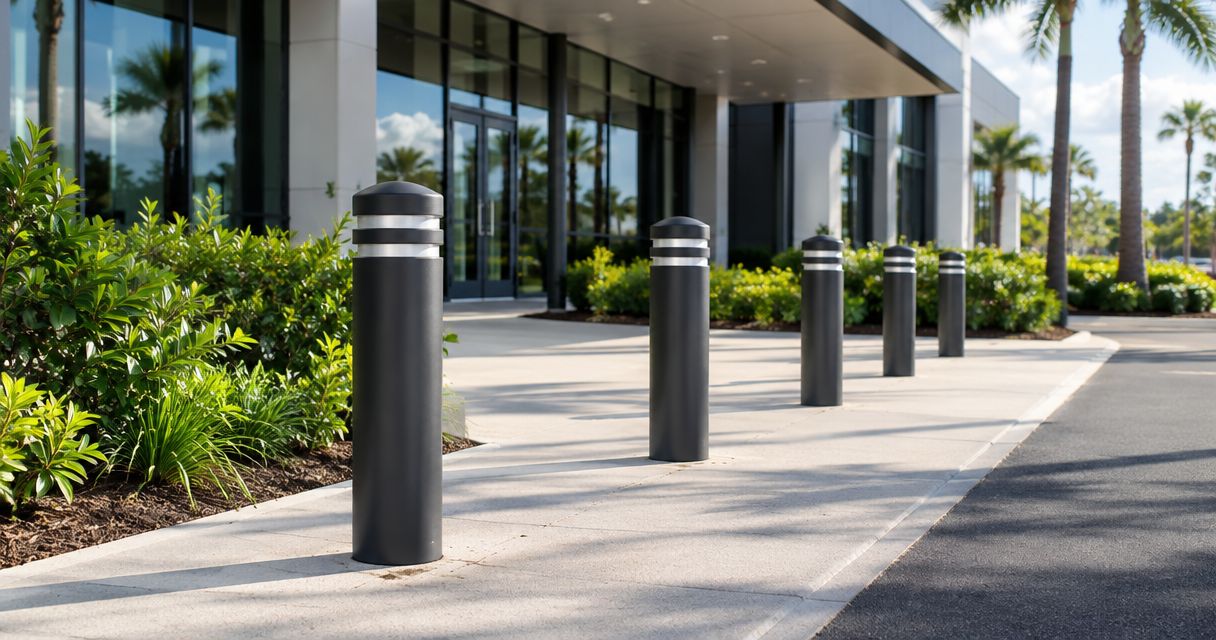
Best overall: concrete-filled steel pipe bollards. Best for decorative storefronts: precast concrete bollards. Best budget option: removable steel bollards in sleeves. Those are the three picks for Florida commercial properties in 2026, and the rest of this page explains why.
- Concrete-filled steel pipe bollards are the best bollard type for commercial Florida properties in 2026: strong, cheap to maintain.
- Precast concrete bollards fit storefronts and plazas where looks matter as much as protection.
- Removable bollards suit fire lanes and service access, but the sleeve needs regular cleaning.
- Plastic and flexible bollards guide traffic only. Skip them where a vehicle strike is a real risk.
- Footing depth, soil and drainage decide performance more than the bollard material.
Green Hammer Concrete pours footings, slabs and sidewalks in Palm Bay and Brevard County, so this guide is written from the ground up: what sits below the bollard matters as much as the bollard.
Why this matters in 2026
A bollard that fails costs more than the bollard. Parking lots, storefronts, gas pumps, dumpster pads and building corners all get hit by vehicles, and Florida adds salt air, heavy afternoon rain and sandy soil to the problem.
Sandy soil does not hold a shallow footing well. Saturated sand loses grip, so a bollard set in a thin footing can lean or shift after a few wet seasons. For wider context on pouring for local conditions, see our guide to concrete options for hurricane-prone Florida properties.
What makes the best bollard for a commercial property
Use these criteria to audit the ranking before you read the table:
- Impact protection: Does it stop a vehicle, or only mark a boundary?
- Corrosion resistance: Florida humidity and salt air attack bare steel and low-grade coatings.
- Footing and anchoring: Does it need a deep concrete footing, or a surface plate?
- Maintenance: How often does it need repainting, cleaning or replacement?
- Appearance: Does it suit a storefront, a medical office or an industrial yard?
- Access needs: Do you need to remove it for deliveries, fire lanes or utilities?
Bollard types at a glance
| Rank | Bollard type | Best for | Standout feature | Key limitation |
|---|---|---|---|---|
| 1 | Concrete-filled steel pipe | Building corners, fuel and equipment protection | Strong, simple, low upkeep | Plain look unless covered or painted |
| 2 | Precast concrete | Storefronts, plazas, walkways | Heavy, finished appearance | Can chip; heavy to place |
| 3 | Removable steel in sleeve | Fire lanes, service access | Opens the path when needed | Sleeve fills with debris and water |
| 4 | Cast-in-place concrete | Custom shapes and decorative finishes | Matches surrounding paving | Longer cure and more labor |
| 5 | Plastic or flexible | Traffic guidance, parking striping | Low cost, forgiving on impact | No vehicle stopping power |
1. Concrete-filled steel pipe: best bollard for impact protection
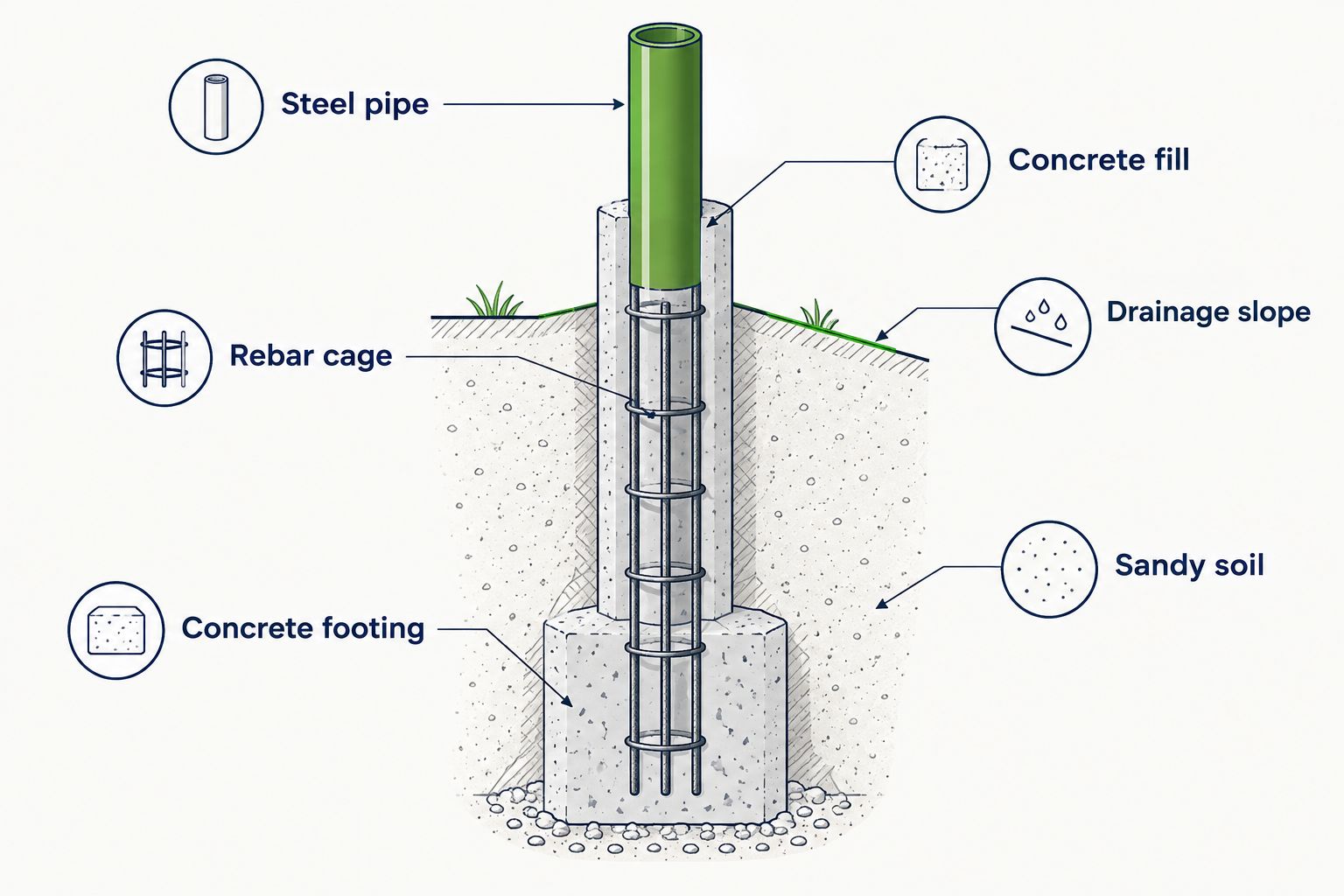
A steel pipe set in a concrete footing and filled with concrete is the standard for protecting buildings, gas meters, electrical equipment and storefront glass. The fill stiffens the pipe, and the footing holds it in the ground.
Concrete-filled steel pipe pros:
- Strong against vehicle bumps and low-speed strikes
- Simple to install and repair
- Low cost compared with custom decorative options
- Easy to repaint in a color that fits the property
Concrete-filled steel pipe cons:
- Bare steel rusts in Florida humidity if the coating is poor
- Plain look, though sleeves and covers fix that
- Needs a properly sized footing; a shallow pour defeats the purpose
Best for: building corners, gas and utility protection, loading areas. Verdict: Buy.
2. Precast concrete bollards: best bollard for storefronts and plazas
Precast bollards are made off-site, then set into a prepared base. They look finished on day one and hold up well in sun and rain.
Precast concrete pros:
- Clean, uniform finish
- No rust to manage
- Matches sidewalks and plaza paving
Precast concrete cons:
- Heavy to deliver and set
- Corners can chip under repeated bumps
- Lower flexibility in height and shape than a custom pour
Best for: retail frontage, walkways, shopping plazas. Pair with a sealer; our guide to concrete sealers for Florida heat and humidity covers the options. Verdict: Buy.
3. Removable steel bollards: best bollard for fire lanes and service access
These sit in a ground sleeve and lift out when you need the lane open. They work for fire access, delivery routes and event space.
Removable bollard pros:
- Keeps access flexible
- Meets needs where a fixed post would block emergency or service traffic
- Same impact role as a fixed post when locked in
Removable bollard cons:
- Sleeves collect sand, water and debris, then the post sticks
- Locks and hardware corrode in humid, salty air
- Needs a routine check so it works when someone needs it
Best for: fire lanes, back-of-house routes. Verdict: Buy, with a maintenance schedule.
4. Cast-in-place concrete bollards: best bollard for custom looks
These are formed and poured on site. The finish can match the surrounding slab, whether broom, exposed aggregate or colored concrete. See exposed aggregate finishes for Florida patios for finish ideas that carry over to site features.
Cast-in-place pros:
- Footing and post form one monolithic piece
- Matches site design
- No joint between base and post
Cast-in-place cons:
- Slower: forms, cure time and labor add up
- Quality depends on the crew and the pour conditions
- Repairs mean patching or breaking out the post
Best for: custom plazas, branded entrances. Verdict: Hold unless the design justifies the extra time.
5. Plastic and flexible bollards: best bollard for traffic guidance only
Plastic and flexible posts bend and return. They mark lanes, guide drivers and protect striping.
Plastic bollard pros:
- Cheap and quick to install
- Forgiving on impact
- Easy to replace
Plastic bollard cons:
- Stop nothing; a vehicle drives over them
- Sun fades and cracks cheaper plastics
- Look temporary
Best for: parking lot guidance, striping protection. Verdict: Skip for anything that needs real protection.
How the footing decides everything
A good bollard in a bad footing fails. Three things matter on Brevard County sites:
- Depth: the footing has to reach below loose surface sand. A contractor sizes it to the post and the expected load.
- Drainage: water pooling at the base softens sandy soil and rusts the post. Slope the surface away from the post.
- Reinforcement: rebar in the footing ties the post to the ground.
Commercial slabs, aprons and walkways around the bollard should be poured at the same time or tied in, so the post does not sit in a separate patch that cracks away. For related ground conditions, see retaining wall materials for Florida sandy soil.
How we ranked
The order follows the criteria above: impact protection first, then corrosion resistance, footing demands, upkeep, appearance and access. Concrete-filled steel pipe leads because it covers the most important criterion at a modest cost. Plastic ranks last because it fails the first test.
Which bollard should you choose in 2026?
- Protecting a building corner, gas meter or equipment: concrete-filled steel pipe.
- Front of a store or plaza: precast concrete, sealed.
- Fire lane or service route: removable steel in a sleeve, with a maintenance check.
- Custom design match: cast-in-place concrete.
- Lane guidance only: plastic.
If you cannot decide, go with concrete-filled steel pipe in a properly sized concrete footing. It is the safest default for a commercial Florida property.
Plan your bollard footings
Family-owned concrete contractor serving Palm Bay and Brevard County.
FAQ
What is the best bollard type for commercial properties in Florida?
Concrete-filled steel pipe bollards are the best all-round choice in 2026. They stop low-speed vehicle impacts and are easy to repaint and repair.
Do concrete bollards hold up in Florida weather?
Yes. Concrete does not rust, so humidity and salt air affect it less than bare steel. A sealer helps protect the surface.
Are removable bollards a good idea for fire lanes?
Yes, when you maintain them. Clean the sleeve and check the lock so the post lifts out when it is needed.
Do plastic bollards stop vehicles?
No. Plastic bollards guide traffic and protect striping, but a vehicle drives over them.
Why does the footing matter so much for a bollard?
The footing holds the post in the ground. In sandy Brevard County soil, a shallow footing lets the post lean or shift.
Can bollards be set in an existing slab?
Often yes, but the slab is cut open and the footing poured below it. A contractor should check the slab and soil first.
Do I need a permit to install bollards?
It depends on the site and the jurisdiction. Check with your local building department before you install.
One last thing
Most bollard failures start below the surface, not in the post. Before you pick a type, ask your contractor how deep the footing goes, what is in the soil and where the water drains. That answer predicts how the bollard performs after the first wet season.