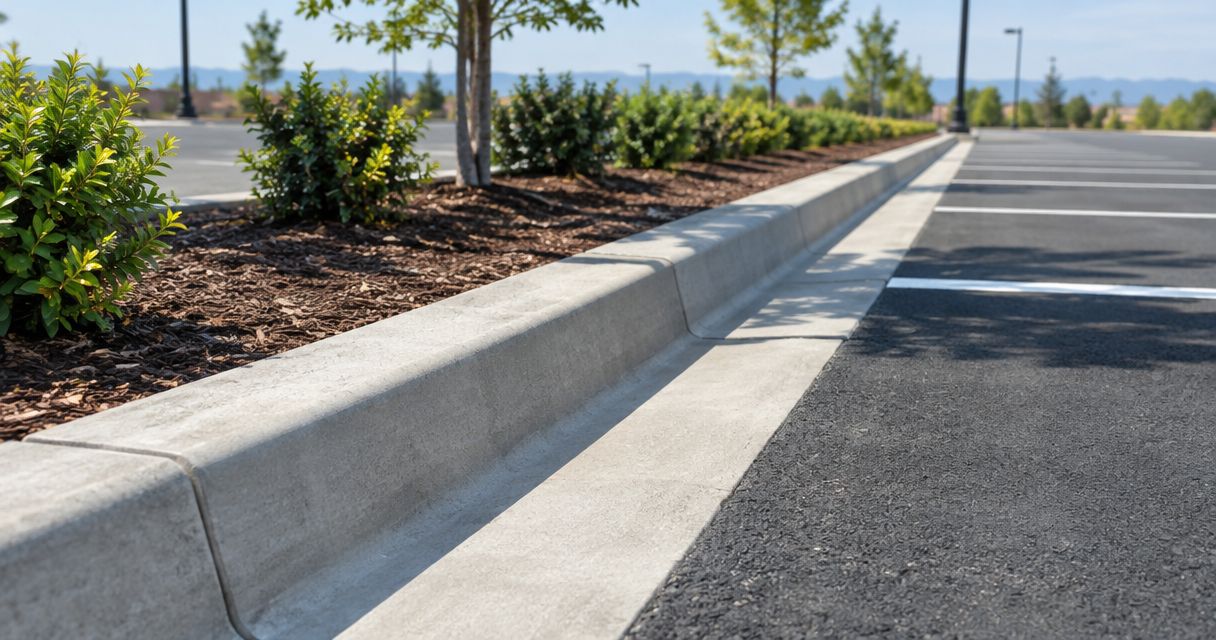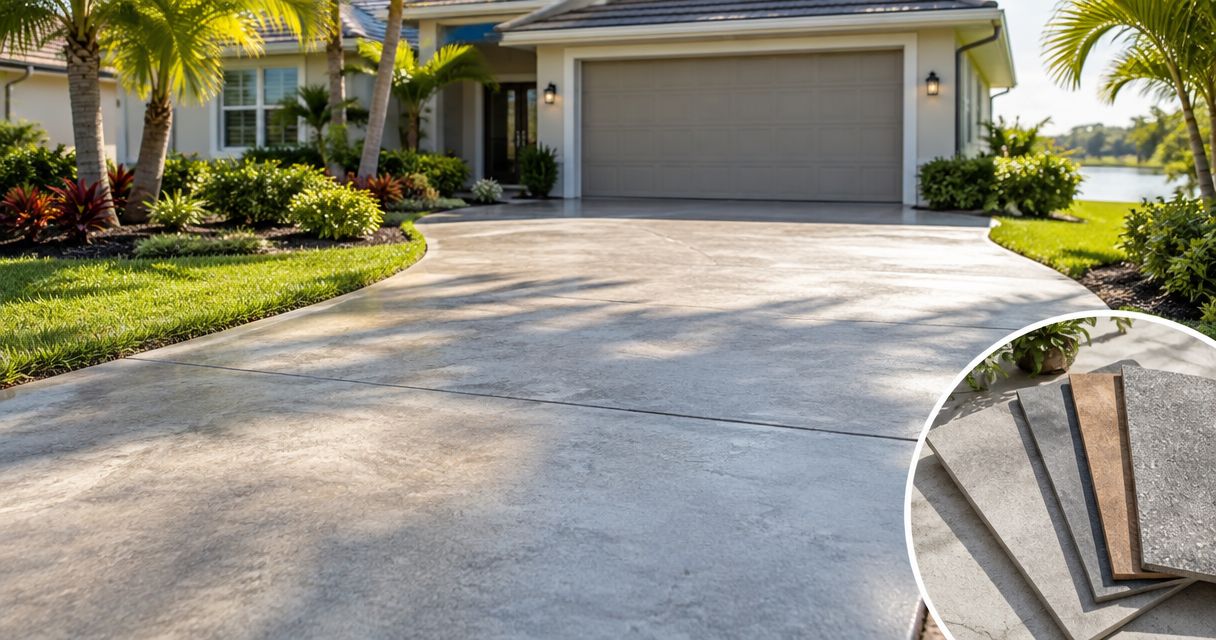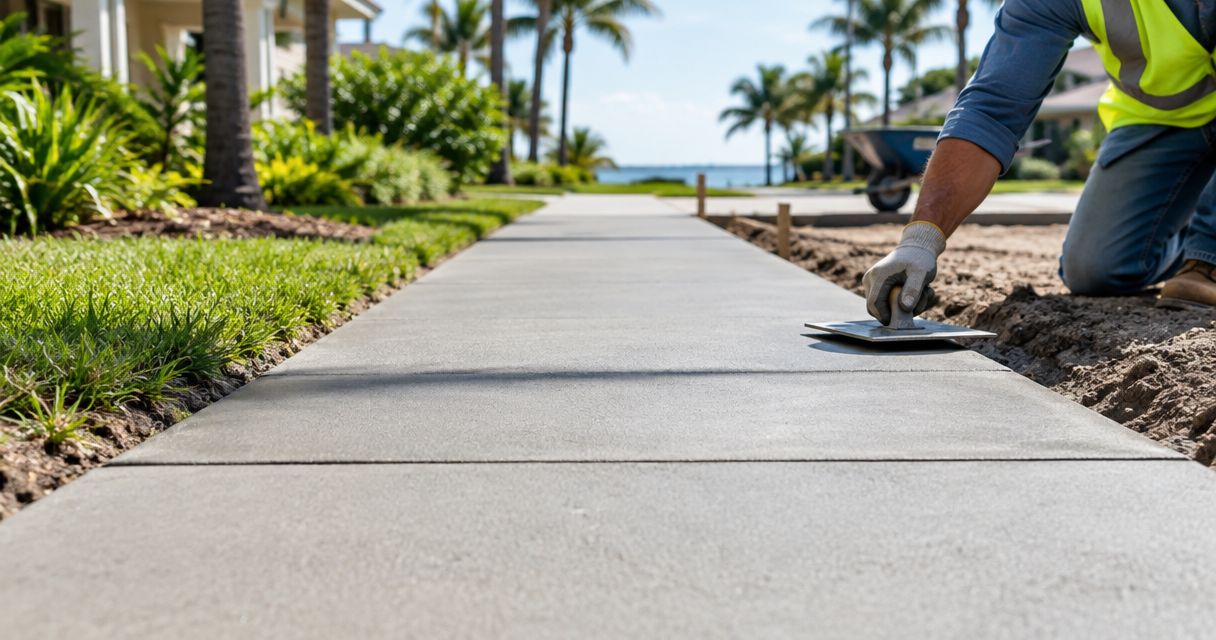
Best overall: broom-finished cast-in-place concrete. Best for crack-width control: fiber-reinforced concrete. Best for panel replacement: precast concrete panels. For Florida municipal sidewalks in 2026, choose the system around accessibility, drainage, repair access and the approved project specifications—not appearance alone.
- Best concrete sidewalk materials Florida: broom-finished cast-in-place concrete is the default for ordinary pedestrian routes.
- Fiber-reinforced concrete supports crack control but does not replace drainage, joints or properly prepared support.
- Precast panels suit planned replacement; pervious concrete needs infiltration design and sediment maintenance.
- Green Hammer Concrete provides concrete sidewalk construction and repair in Palm Bay and Brevard County.
Why this matters
A sidewalk material cannot compensate for a settled base, a blocked swale or a poorly placed joint. Municipal routes also need consistent accessible surfaces through driveway crossings, curb ramps and utility repairs. Specify those details before selecting a decorative finish.
Green Hammer Concrete is a family-owned contractor providing concrete sidewalk construction and repair for residential and commercial property owners in Palm Bay and Brevard County. This guide addresses municipal material selection; municipal project qualifications require a separate procurement review.
The practical decision is not simply which concrete is strongest. It is which system the municipality can construct, inspect and repair without creating drainage problems or abrupt changes along the pedestrian route.
What makes the best concrete sidewalk material?
Use these six criteria when reviewing a 2026 sidewalk specification:
- Accessible surface: Require a firm, stable, slip-resistant walking surface, with compliant slopes, joints and transitions.
- Drainage compatibility: Coordinate sidewalk elevation with swales, driveway aprons, inlets and adjoining property grades.
- Support preparation: Address unsuitable material, utility trenches and compaction before placing concrete.
- Crack management: Specify joint locations, curing and reinforcement where required. Do not treat compressive strength as the entire design.
- Repair practicality: Consider how crews will replace a damaged section and restore the adjoining route.
- Maintenance fit: Match cleaning, sediment removal and surface treatment requirements to the municipality's maintenance program.
Broom-finished cast-in-place concrete is the default for ordinary municipal sidewalks because it combines a textured walking surface with flexible field placement. Special conditions justify the alternatives below.
Concrete sidewalk materials at a glance
These options are not mutually exclusive. Fiber reinforcement changes the concrete mixture; broom finishing and exposed aggregate change the surface. A project can combine fiber reinforcement with a broom finish, for example.
| Rank and option | Best for | Standout feature | Key limitation |
|---|---|---|---|
| 1. Broom-finished cast-in-place concrete | Standard pedestrian routes | Adapts to field grades and connections | Requires controlled placement, curing and jointing |
| 2. Fiber-reinforced concrete | Specified crack-width control | Fibers are distributed through the mixture | Fiber type and dosage need project-specific selection |
| 3. Precast concrete panels | Planned panel replacement | Panels are manufactured before installation | Bedding and panel transitions demand precision |
| 4. Pervious concrete | Engineered infiltration areas | Connected voids allow water through the surface | Sediment can clog the pavement |
| 5. Exposed-aggregate concrete | Civic accent areas | Aggregate provides a distinct surface texture | Rough or uneven exposure can compromise comfort |
1. Broom-finished concrete: best for standard pedestrian routes
Broom-finished cast-in-place concrete is placed on site and textured before it hardens. It suits ordinary sidewalk runs where crews must work around existing grades, driveway crossings and curb ramps. The broom finish provides texture without requiring a decorative surface system.
Broom-finished concrete pros
- Field placement accommodates changing sidewalk alignment and elevation.
- A specified broom texture provides traction without deep decorative grooves.
- Joint layouts can align with crossings, corners and planned repair boundaries.
- Replacement can follow defined slab sections rather than an entire route.
Broom-finished concrete cons
- Poor curing or finishing can damage the surface despite an acceptable mixture.
- Base movement still produces settlement and cracking.
- Replacement sections can differ visibly from older concrete.
For a 2026 municipal project, specify the finish and acceptance requirements together. A direction to provide a broom finish does not settle texture depth, cross slope, joint treatment or drainage at the edge of the walk.
Pay particular attention where driveway traffic crosses the pedestrian route. Those sections need a design that accounts for vehicle loading while preserving the accessible walking surface; a standard pedestrian detail does not automatically cover them.
Best for: Routine neighborhood sidewalks and other standard pedestrian routes.
Verdict: Buy—use broom-finished cast-in-place concrete as the default unless site requirements justify another system.
2. Fiber-reinforced concrete: best for specified crack control
Fiber-reinforced concrete contains fibers distributed through the mixture. Different fiber types serve different purposes: microfibers commonly address plastic-shrinkage cracking, while suitable macrofibers can provide post-crack performance when included in an engineered design.
Fiber reinforcement is not a surface finish. A sidewalk can use an approved fiber mixture and still receive the broom finish recommended for a conventional walking route.
Fiber-reinforced concrete pros
- Distributed fibers provide crack-control functions throughout the mixture.
- Fiber selection can address a defined performance requirement.
- The system remains compatible with conventional cast-in-place sidewalk geometry.
Fiber-reinforced concrete cons
- Fibers do not prevent settlement caused by inadequate support.
- Fiber types are not interchangeable, and dosage matters.
- Fibers do not automatically replace specified bars, mesh or joints.
Ask the designer to identify the required function before accepting a fiber substitution. A generic note stating that concrete contains fibers does not establish structural equivalence or eliminate the need for proper joint spacing and curing.
Finish a sample when surface appearance matters. Fiber selection and finishing practice can affect the visible surface, so acceptance should address the completed walking surface rather than the mixture alone.
Best for: Projects whose specifications identify a particular crack-control or post-crack performance requirement.
Verdict: Buy when specified—do not purchase fiber reinforcement as a cure for weak support or poor workmanship.
3. Precast concrete panels: best for planned panel replacement
Precast concrete panels are manufactured before delivery and installed on prepared support. They suit projects designed around repeatable panel dimensions, lifting access and future removal. The municipality must resolve the connection and bedding details before installation.
Precast concrete panel pros
- Defined panel dimensions support repeatable replacement planning.
- Manufacturing separates panel casting from on-site placement conditions.
- Removable panel arrangements can support planned access where the design allows it.
Precast concrete panel cons
- Poor bedding creates rocking panels or uneven transitions.
- Lifting equipment and delivery access affect installation logistics.
- Replacement requires compatible panel dimensions and connection details.
Precast concrete is a system decision, not simply a different concrete mixture. Review panel tolerances, edge support, joints and lifting provisions together. A panel that meets its manufacturing requirements can still form an unacceptable walking surface if installation leaves uneven edges.
For utility-heavy corridors, confirm who owns replacement inventory and how crews will restore support after excavation. The maintenance plan should explain how the route returns to service with flush, stable transitions.
Best for: Corridors with a planned panel-replacement strategy and suitable installation access.
Verdict: Hold until bedding, transitions and replacement arrangements are documented.
4. Pervious concrete: best for engineered infiltration areas
Pervious concrete contains interconnected voids that allow water to pass through the pavement. Its usefulness depends on the complete drainage design, including the supporting reservoir, underlying soils, groundwater conditions and overflow route.
Pervious concrete pros
- The pavement surface allows water to enter a designed infiltration system.
- It can form part of a site-specific stormwater management approach.
- It provides an alternative where the project deliberately integrates pavement and drainage.
Pervious concrete cons
- Sediment can clog the voids and reduce infiltration.
- Unsuitable groundwater or soil conditions limit the drainage design.
- Placement, curing and cleaning require procedures suited to pervious pavement.
Do not specify pervious concrete merely because a Florida site has sandy soil. Investigate the actual subsurface conditions and seasonal groundwater constraints. Also identify where sediment will originate: adjacent unprotected soil and construction runoff can undermine the intended drainage function.
For 2026 procurement, require a maintenance plan alongside the pavement detail. Confirm how the surface will be cleaned and how its condition will be checked. Pervious concrete still needs an accessible surface; drainage benefits do not excuse rough transitions.
Best for: Sites with an engineered infiltration design and an assigned maintenance program.
Verdict: Hold until drainage feasibility and maintenance responsibilities are confirmed.
5. Exposed-aggregate concrete: best for civic accent areas
Exposed-aggregate concrete reveals aggregate at the surface rather than leaving a conventional paste finish. It provides a decorative texture for selected public spaces, but aggregate selection and exposure depth determine how the walking surface feels.
Exposed-aggregate concrete pros
- Aggregate provides visual distinction without relying solely on a coating.
- Selected areas can mark a plaza edge or civic entry.
- A project mock-up allows texture and appearance review before full placement.
Exposed-aggregate concrete cons
- Uneven exposure can create an unnecessarily rough walking surface.
- Repairs can be difficult to match in aggregate and appearance.
- Decorative intent does not establish accessibility or slip resistance.
Keep decorative treatment subordinate to the pedestrian route. Review a representative mock-up for surface consistency, transitions and cleaning—not just color. Loose particles and uneven exposure are acceptance issues, not decorative character.
The related guide to exposed-aggregate finishes for Florida patios addresses a different setting; patio finish choices do not establish municipal sidewalk compliance.
Best for: Limited civic accent areas with an accepted surface mock-up.
Verdict: Skip as the default route finish; consider it only where the approved texture supports pedestrian use.
Check accessibility before approving the finish
For 2026 design review, distinguish building-site accessible routes from pedestrian facilities in the public right-of-way. The U.S. Access Board publishes separate accessibility guidance and standards addressing these settings. Confirm the requirements adopted by the authority responsible for the project.
Under the ADA Standards' general walking-surface provisions:
- A vertical change in level up to 1/4 inch is permitted.
- A change above 1/4 inch and up to 1/2 inch must be beveled, with a slope no steeper than 1:2.
- Larger changes require treatment under the applicable ramp or curb-ramp provisions.
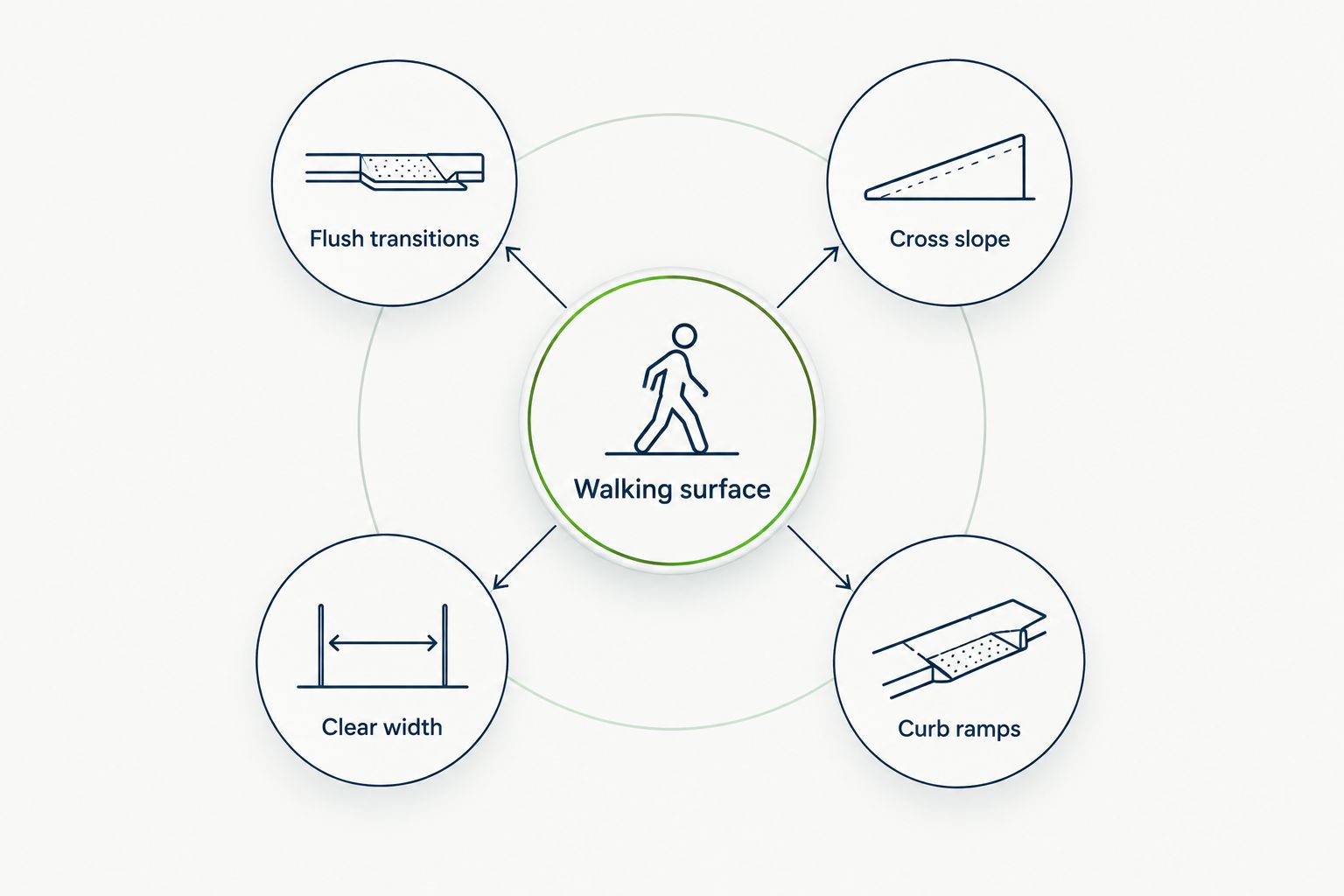
Those dimensions describe allowable changes in level, not construction targets. Specify flush transitions wherever possible, and confirm separate requirements for running slope, cross slope, clear width and curb ramps.
Inspect joints and utility covers as part of the same route. A compliant concrete panel does not resolve a raised cover or settled adjoining section. Green Hammer Concrete's concrete sidewalk construction and repair services serve residential and commercial properties; municipal acceptance remains tied to the governing plans and specifications.
How the ranking works
This ranking prioritizes accessible surface design, drainage coordination, support preparation, crack management and repair practicality. It is a specification guide, not a laboratory comparison or contractor qualification list.
Broom-finished concrete takes the default position because it fits ordinary field-placed sidewalk work. The other options earn distinct roles only when the project needs their particular function. None removes the need for suitable support, drainage and inspection.
Which concrete sidewalk material should you choose?
Choose broom-finished cast-in-place concrete for a standard municipal sidewalk in 2026. Add specified fibers when the design calls for them. Choose precast panels for a documented replacement strategy, pervious concrete for engineered infiltration, and exposed aggregate for controlled accent areas.
Before tendering, settle who approves the subgrade, who verifies finished elevations and what triggers removal of unacceptable work. Those responsibilities matter more than adding another adjective to the concrete specification.
For residential or commercial sidewalk work in Palm Bay and Brevard County, Green Hammer Concrete provides construction and repair services. Keep that service scope separate from the qualification requirements of a municipal contract.
FAQ
What's the best concrete sidewalk material for Florida municipalities?
Broom-finished cast-in-place concrete is the default recommendation for ordinary municipal pedestrian routes. The approved design still needs to address support, drainage, joints, loading and accessibility.
Is fiber-reinforced concrete better than regular sidewalk concrete?
Fiber-reinforced concrete is better only when its specified function matches the project's needs. Fiber type and dosage matter, and fibers do not automatically replace reinforcement, joints or proper support.
Should Florida municipal sidewalks use pervious concrete?
Use pervious concrete only where an engineered drainage design supports it. Soil conditions, groundwater, sediment exposure and maintenance responsibilities determine whether it fits the site.
Are precast concrete sidewalk panels easier to repair?
Precast panels support planned replacement when compatible panels, lifting access and installation details are available. Poor bedding or uneven panel edges can still create walking-surface problems.
Is exposed-aggregate concrete suitable for an accessible sidewalk?
Exposed aggregate requires a surface design that meets the applicable accessibility requirements. Approve a representative mock-up and review texture, transitions and consistency before using it on the route.
Does stronger concrete prevent sidewalk cracks?
Higher compressive strength alone does not prevent sidewalk cracks. Support movement, shrinkage, curing, loading and joint layout also affect performance.
What should a municipality check before approving sidewalk concrete?
Check the governing specification, accessibility requirements, drainage design, support preparation and acceptance procedures. Confirm responsibility for inspection and correction before construction starts.
One last thing
Inspect the route after adjacent work is complete, not only when the concrete is finished. Landscaping, driveway connections and utility adjustments can change drainage or leave uneven transitions. Include that final walk-through in the acceptance plan.